Shiff the Gunman
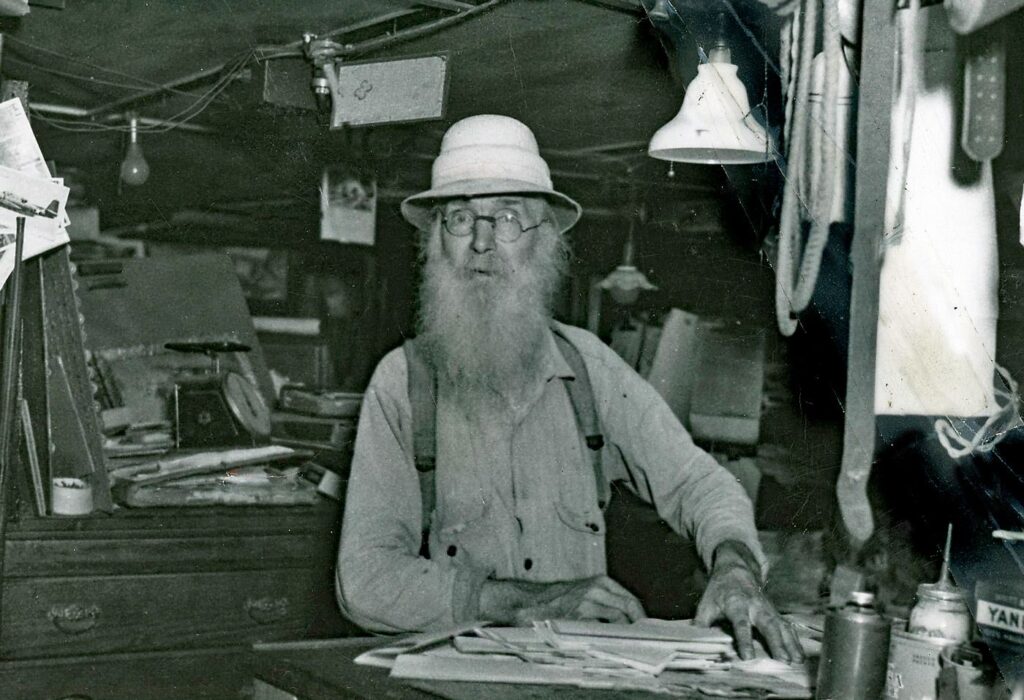
“Shiff the Gunman”
Carroll Barrows Shiffer did not arrive in the world in a covered wagon on the Great Plains, nor did he grow up hunting buffalo and fighting Indians beneath the open sky of the Rocky Mountains. He was born on February 21, 1878, in Tilton, New Hampshire, the only son of the Rev. James Knox Shiffer and Ella Josephine Barrows. His mother died when he was just a year old. His father would outlive her by nearly four decades.
And yet, by the time he reached old age, that quieter beginning had largely been replaced—by design, perhaps—by a more expansive story. In gun rooms and collectors’ magazines across the country, he was known instead as “Shiff the Gunman,” a man whose life seemed to stretch backward into the nineteenth century and outward across the American West, whether or not the record could always follow.
That tension—between fact and legend, documentation and desire—lies at the heart of Shiff’s story.
After his mother’s death in 1879, Shiff spent his early years moving between relatives in New Hampshire and Massachusetts. His father remarried, and a half-brother, James Arthur “Jim” Shiffer, was born in 1886. The family was unsettled, and so was Shiff’s early life. At some point in his youth, he went west with his father, working around the railroads and living for a time in Iowa. These years are thinly documented, preserved mostly through later recollection—his own and others’—and often embroidered with flair.
What is certain is that Shiff eventually returned to New Hampshire around 1916, the year his father died. Not long afterward, he settled in North Woodstock, where he would remain until his death in 1952. By then, he had already begun to reinvent himself, consciously shaping not just a livelihood but a presence.
In 1940, the firearms historian Ned Henry Roberts published The Muzzle-Loading Cap Lock Rifle, a foundational text in the study of early American arms. In its preface, Roberts devoted an entire page to Shiff—accompanied by a photograph of him holding an S. Hawken “Plains Rifle”—and presented a biography that reads like a frontier epic.
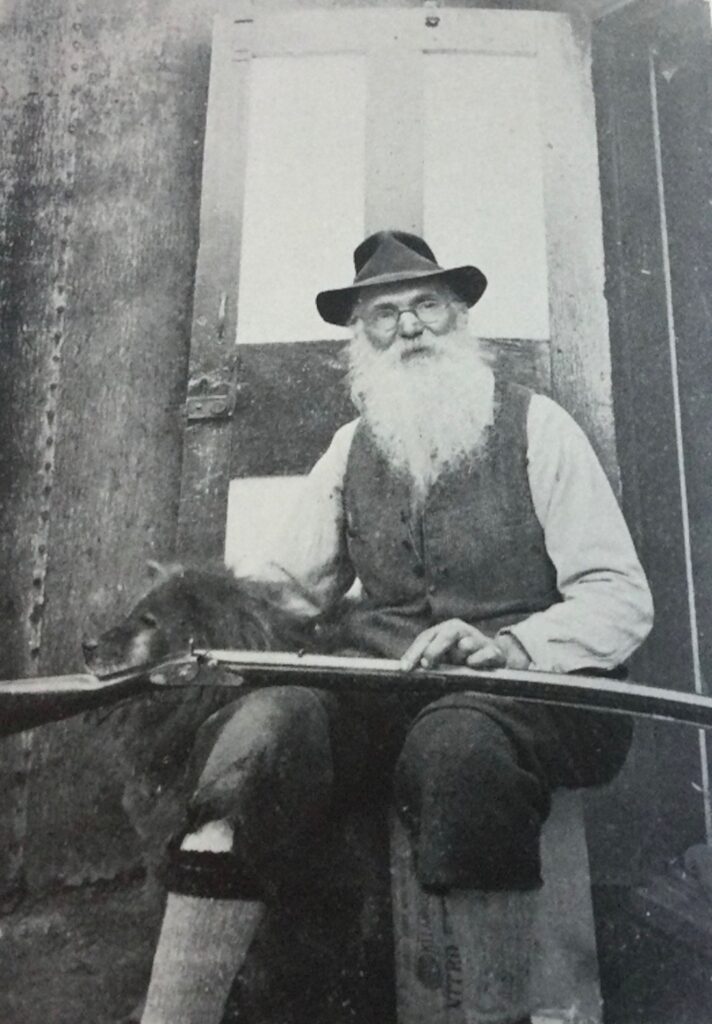
“Shiff the Gunman,” North Woodstock, New Hampshire, with his S. Hawken “Plains Rifle.”
According to Roberts, “Carl B. Shiffer” was born in Montana Territory in 1855, grew up hunting big game and fighting Indians, wore a Colt Peacemaker as constantly as his trousers, helped build the Northern Pacific Railway and Georgia Central Railway, as a “Civil Engineer,” and settled in North Woodstock in 1881, where he became one of the foremost authorities on obsolete arms in North America. He was, Roberts wrote, “one of the last of the old pioneers and plainsmen,” fluent in multiple classical languages, including Greek, Latin, and Spanish, despite having only “sixteen weeks” of formal schooling.
None of this aligns with the documented record. And yet, it would be a mistake to dismiss the passage as mere error.
Roberts was not an uncritical admirer. He was a careful student of firearms history, and his decision to reproduce this account—so specific, so confident—suggests that the legend had become inseparable from the man. Shiff himself never publicly corrected it. On the contrary, he appears to have embraced it, allowing biography and persona to blur into something more useful than accuracy: authority.
Whatever the truth of his early years, Shiff’s later life is unmistakable. From a small cabin and workshop in North Woodstock, he built one of the most remarkable private firearms collections in New England—and possibly the country.
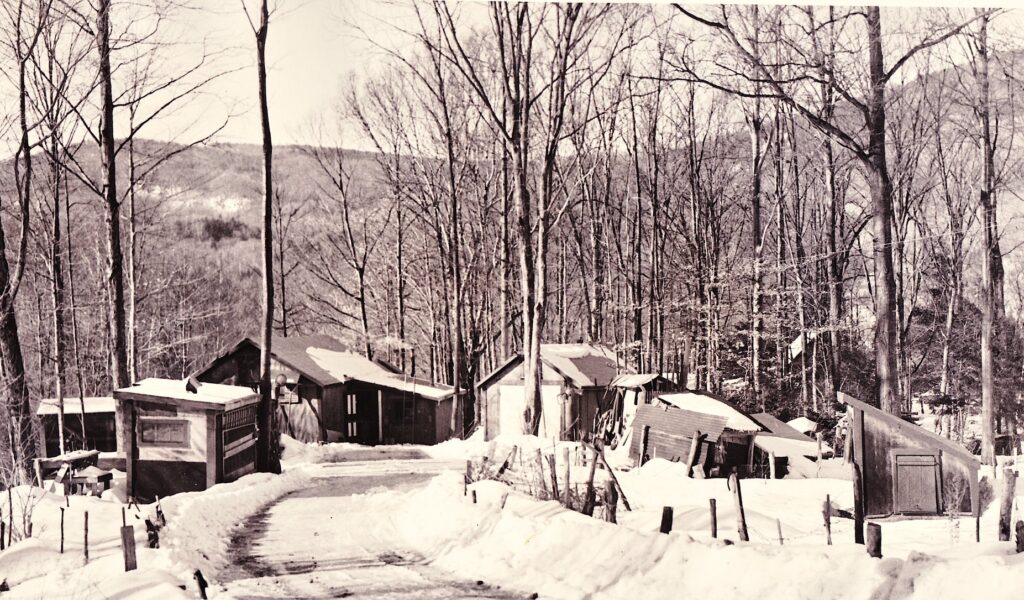
Shiff the Gunman’s property and residence on Eastside Road (or Route 175) in North Woodstock, New Hampshire.
He was a dealer, collector, and correspondent, operating largely by mail. His mimeographed catalogs and letters circulated widely, advertising Winchesters, Sharps rifles, flintlocks, revolvers, ammunition, and obscure accessories that many collectors had never seen. He advertised in early collector publications such as Hobbies, and his reputation for “square dealing” was widely acknowledged.
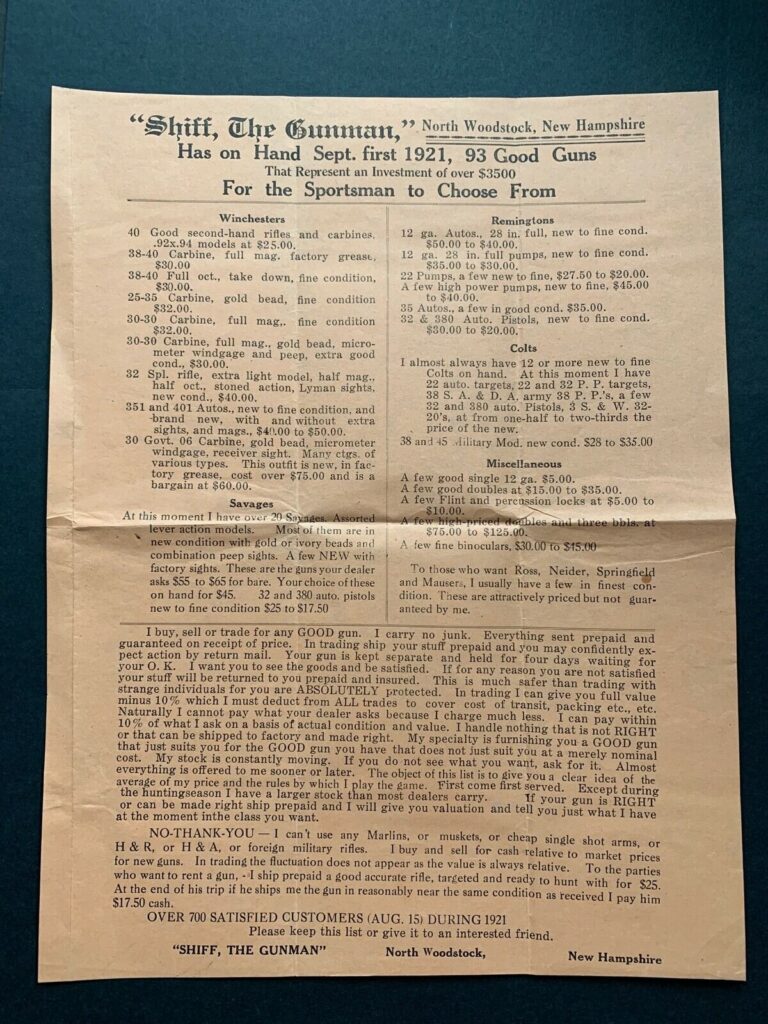
Image courtesy of John Currier.
Within his home were not only guns, but the material residue of a carefully curated identity: cartridge boards, rare ammunition, old holsters, horns, belts, hats, chaps, spurs, and handcuffs—objects that reinforced the image of a man who had lived hard, far from institutions, and on his own terms.
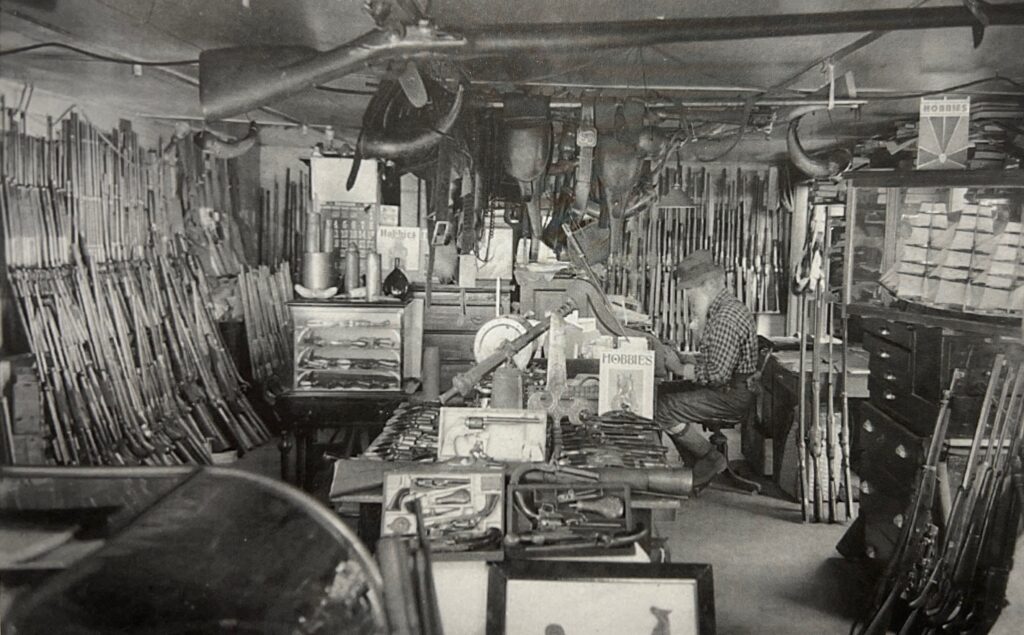
Shiff the Gunman in his Gun Shop, North Woodstock, New Hampshire.
Shiff was, for a time, a District Ranger for the U.S. Forest Service. But he was not, by temperament, a bureaucrat. Those who visited him remembered a man intensely self-sufficient, even ritualistic. Surprisingly, he had a telephone, but it was for “outgoing calls only.” Guinea hens announced visitors before they reached the door; a Chow dog completed the alarm. Near the entrance stood a Winchester Model 1897 pump shotgun. A Smith & Wesson revolver rode in his pocket. A soft wool hat adorned his head; wool socks, his feet. Business was conducted one customer at a time.
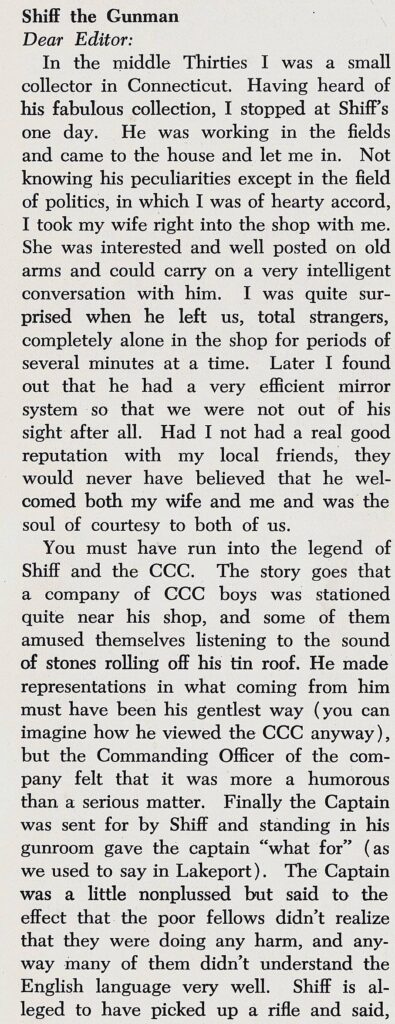
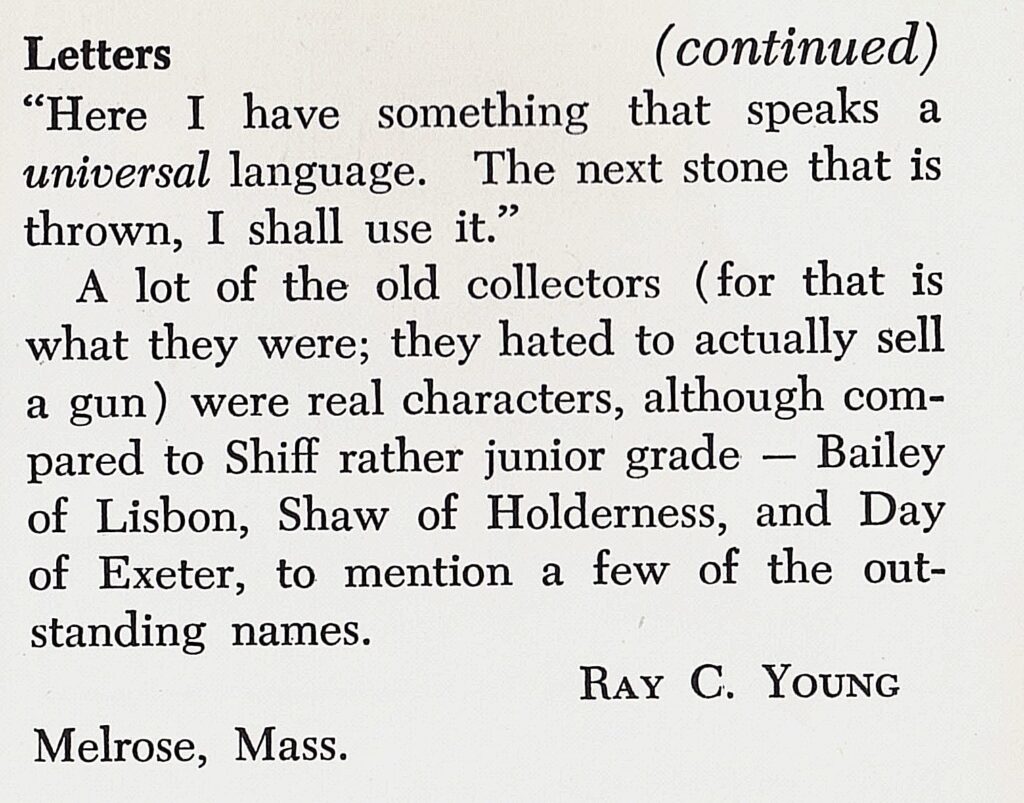
A Letter to the Editor by Ray C. Young of Melrose, Massachusetts.
Small tests governed entry into his world. A dime placed deliberately on the doorstep was not spare change but a signal. Visitors were expected to notice it—and to stomp on it before crossing the threshold. Those who stepped over it without acknowledgment revealed, in Shiff’s view, a lack of attention. He took note.
He carried his money in a cloth drawstring bag, heavy with bills. He spoke deliberately, often holding up a finger and asking for patience if interrupted. The stories told about him—of a man who once shot a suffering cow himself rather than allow it to linger, or who quietly refused business to those he judged careless or dishonest—reinforced the sense that everything he did followed a private code.
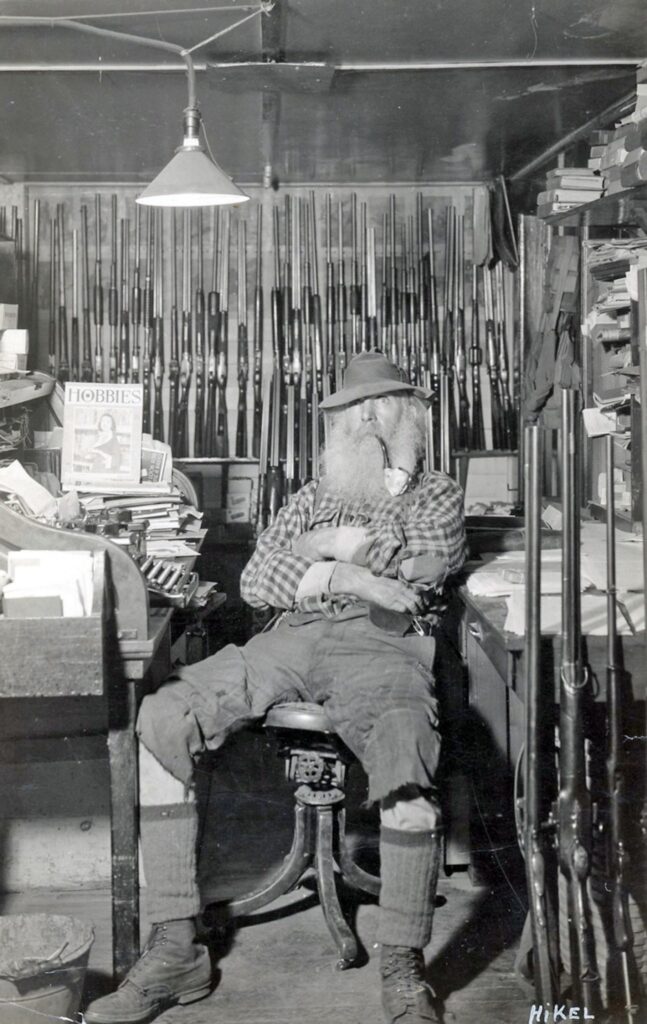
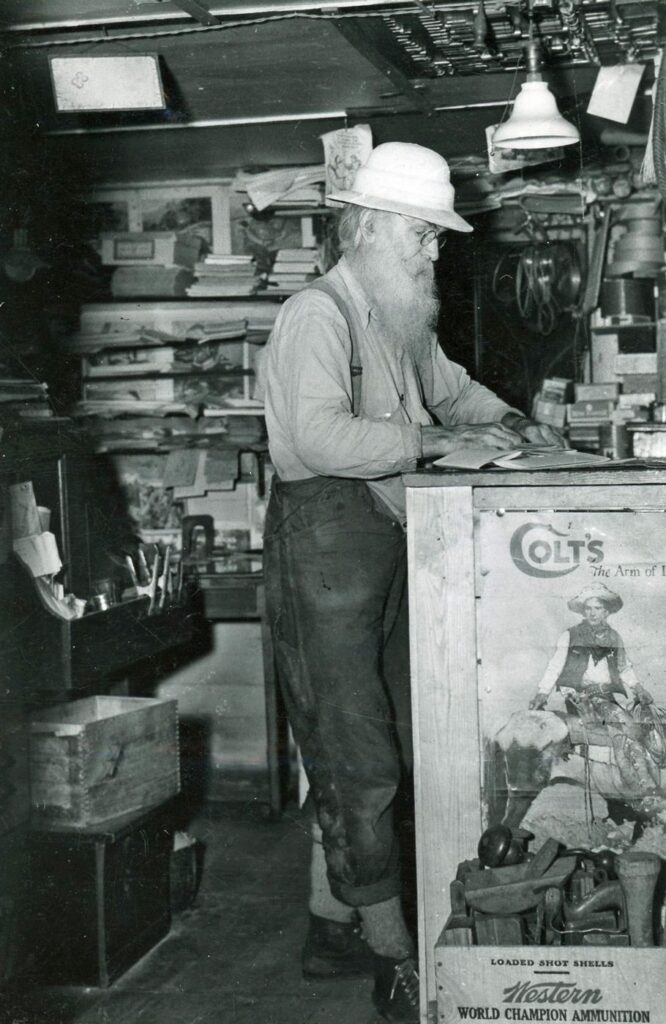
Shiff the Gunman in his Gun Shop, North Woodstock, New Hampshire.
He was also deeply political. Friends recalled long, animated conversations about national and world affairs, delivered with wit and philosophical confidence. He was widely understood to despise Franklin D. Roosevelt and the New Deal. Local memory holds that open admiration for the president could cost a customer a sale. He put those views into print—through letters to editors or publishers—, and he was known to circulate pointed mimeographed letters criticizing those who tried to take advantage of him.
Shiff’s politics were of a piece with his lifestyle: anti-centralization, anti-interference, fiercely and ruggedly individualist.
When Carroll Barrows Shiffer died on August 21, 1952, in Woodstock, New Hampshire, he was buried in the Woodstock Cemetery. He left behind not only a reputation but a collection of extraordinary scope.
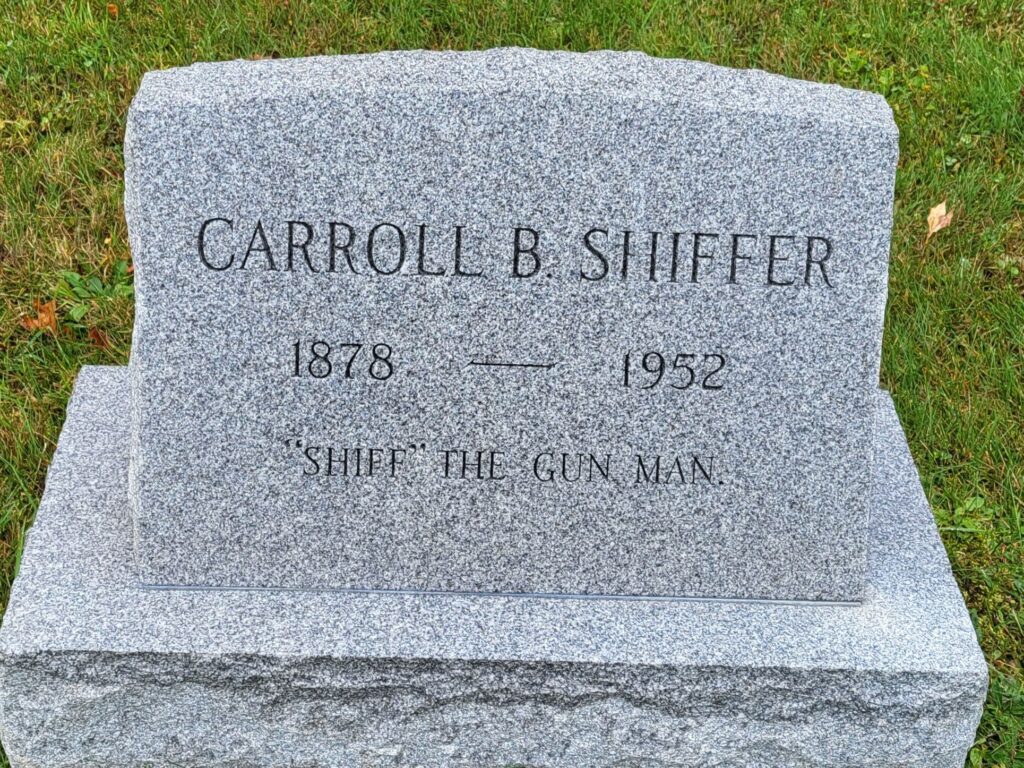
Headstone at Woodstock Cemetery, Woodstock, New Hampshire
After his death, his firearms and related materials were sold through a 47-page catalog issued by “The Shiff Associates” of Danvers, Massachusetts. The dispersal did not diminish his legacy; it multiplied it. Objects bearing his name have continued to surface in major auctions, often accompanied by letters, photographs, and provenance that trace back to his cabin in North Woodstock.
In November 2024, the Amoskeag Auction Company sold a large Union Metallic Cartridge Company framed cartridge display board from the “Shiff the Gunman” collection for $19,360, buyer’s premium included. The board—measuring more than four feet across and displaying over 200 cartridges, from .22 rimfire to a one-inch Gatling gun round—was accompanied by correspondence between Shiff and a collector, Richard Quigley, Jr., who purchased it from him in 1950.
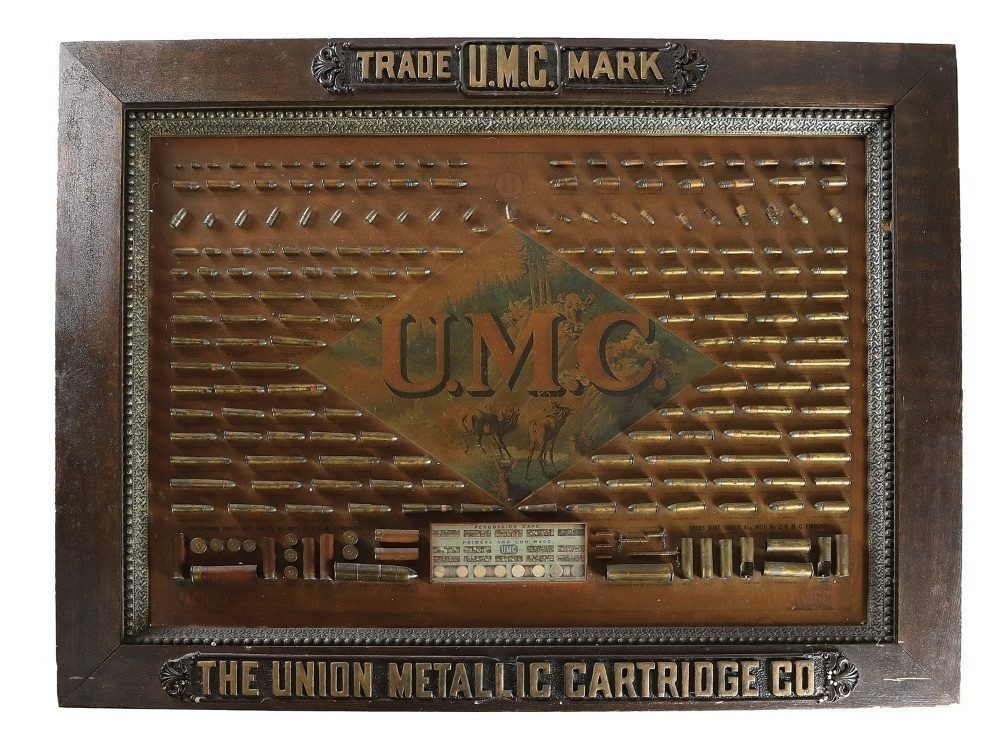
“Fine and Very Desirable U.M.C. Framed Cartridge Display Board From The “Shiff The Gunman” Collection.”
The catalog description referred to Shiff as a “New England firearms legend” and “one of the most unusual personalities in the old gun business.” The phrasing feels less like hyperbole than inheritance.
Shiff’s life resists clean resolution. The facts we can document are compelling enough: a semi-orphaned child, a wandering youth, a federal ranger, and finally a solitary dealer who transformed his home into a node of self-sustainability and national exchange. But the legend he allowed to grow around himself tells us something equally important—about the power of narrative in American collecting culture, and about a man who understood that history is shaped not only by what is true, but by what endures.
Carroll Barrows Shiffer did not need to be born in a covered wagon to matter. He built his authority deliberately, object by object, letter by letter, reputation by reputation. The myth followed because it fit.
And in the end, perhaps that was the most frontier thing about him.
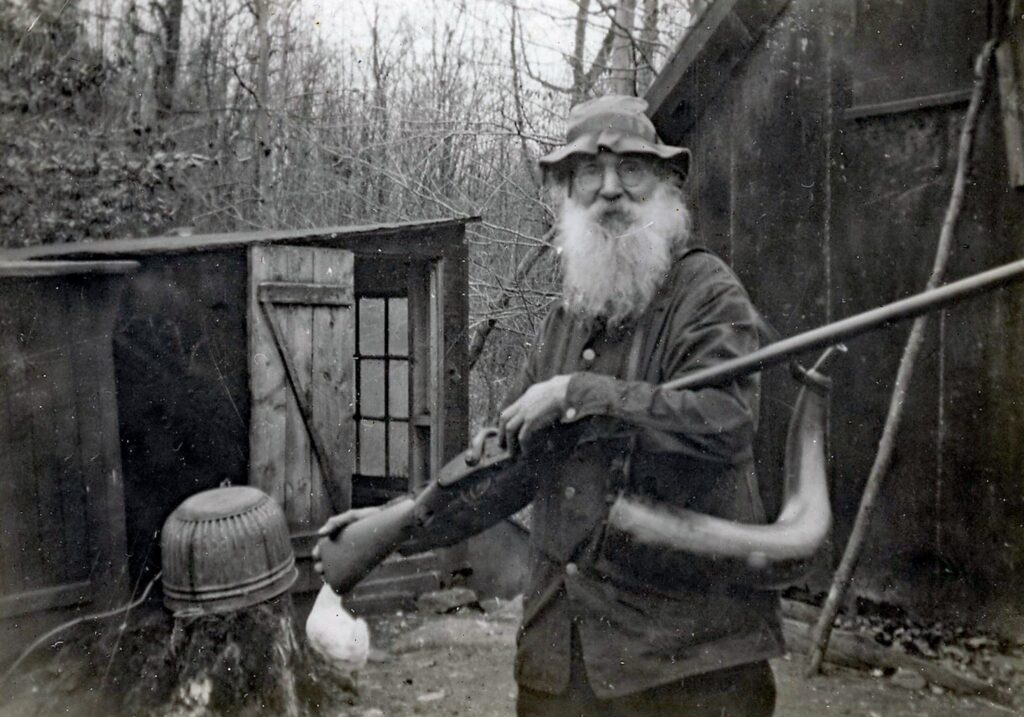
Shiff the Gunman at his home in North Woodstock, New Hampshire.
NOTES
- Roberts, Ned Henry. The Muzzle-Loading Cap Lock Rifle. Harrisburg, PA: The Military Service Publishing Company, 1940.
- Amoskeag Auction Company, Inc. Fine and Very Desirable U.M.C. Framed Cartridge Display Board From the “Shiff the Gunman” Collection. Lot 201, Auction 144, Two Day Sale, November 23–24, 2024.
- Lunn, Gerald. Headstone of Carroll Barrows Shiffer (Shiff the Gunman), Woodstock Cemetery, Woodstock, New Hampshire. Photograph, October 29, 2023. Find a Grave.

