Camp 22: The Loyal Legion of Loggers
28 South Mass., December 31, 1928
Dear Mother and Father,
Having once again returned to the friendly shelter of South Mass., after a sojourn away from civilization, I will try to give you some account of my experiences.
Thursday night, after school closed, I skied into Franconia Notch by myself and spent a very lonely evening. The next morning, I commenced skiing down the notch over the new-fallen snow, but was offered a ride before I had reached the Profile. My benefactor, a Mr. Clough, entertained me all the way to Lincoln with the achievements of his ancestors. He told a touching story about his grandfather’s great-grandfather’s grandmother, an Indian maiden who had healed his remote ancestor’s broken leg and seduced him with her charm. His own father, he asserted, was a mighty man, being endowed with two spinal columns. He could lift 900 lbs. with his bare hands, but he evidently placed little value on this temporal asset. He felt the call in an early life and became a Methodist minister. He used to step out on the platform and have his audience in the last stages of hilarity, then in five minutes strong men would weep.
Sherm Adams, the woods boss of the Parker Young Co., was not in Lincoln when I arrived so I spent the day loafing around the village. I made a careful inspection of the pulp and paper mill and in the afternoon walked out to one of the big log dams on the east branch of the Pemigewasset River. Sherm pulled in after supper and told me he could give me a job. He asked me to his house for the night and I had a very pleasant evening. He was president of the Outing Club in 1920 and was the originator of Cabin and Trail.
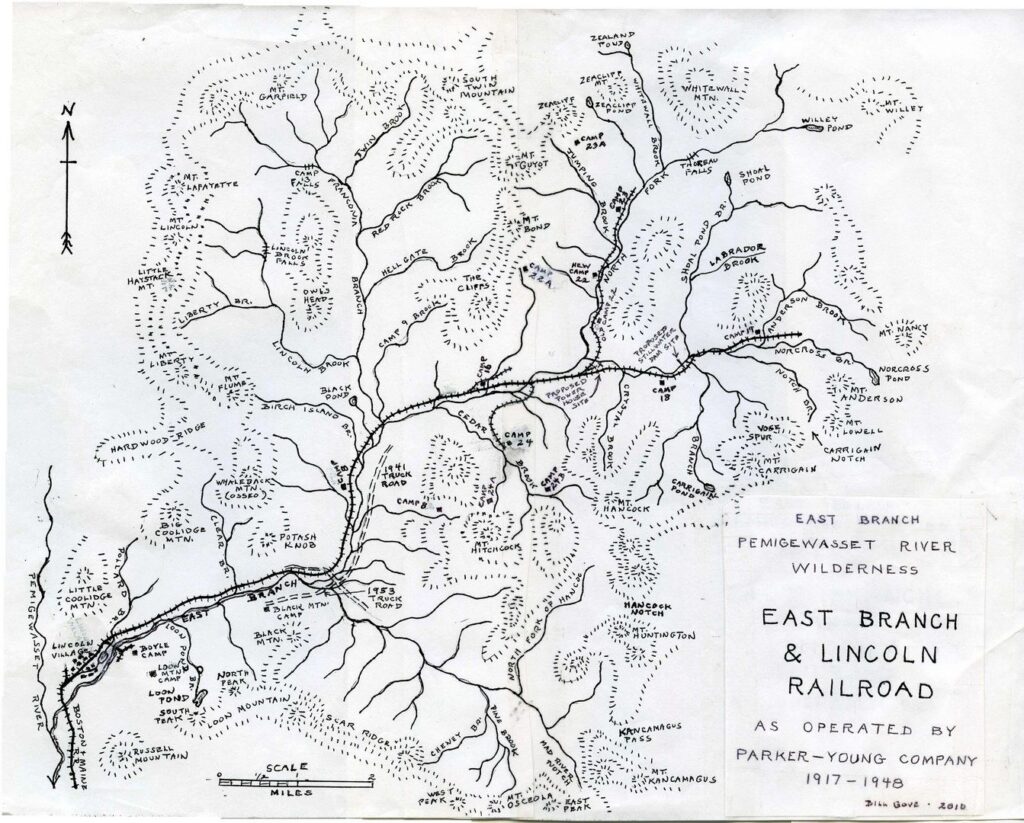
East Branch – Pemigewasset River Wilderness – East Branch & Lincoln Railroadas operated by Parker-Young Company, 1917-1948 (Bill Gove, 2010)
I caught the woods train the following morning as she was coaling in the yards. After a scenic ride in a caboose up the main line of the East Branch and Lincoln R.R., the private road of the Parker Young Co., I was deposited at my destination, Camp 22. The walking boss, Mr. Boyle, told me I could not be assigned to a job till the afternoon, so I spent the morning loafing around the sleeping shack, listening to the chatter of some Canucks who were sick and had laid off for the day. The camp consisted of the large barn-like sleeping shack, the smaller cook shack, the stables, and four or five miscellaneous shanties occupied by the smithy, the office, and the clerks’ quarters. The buildings were all grouped near the railroad. They were frame structures, painted red a great many years ago. The sleeping shack on the lower floor was lined with cell-like dens, each occupied by two men. The loft overhead was filled with wide beds, arranged in three rows under the low gables. Gray-green, dingy, and filthy, but not, thank God, graced by the expected odors. Except for the smell of musty tobacco smoke the air was quite breathable. The crumb boss or shackman, a feeble little Pole called Mike, gave me one of the end beds in the loft, which I shared with an old Irishman, Tim Hart. The camp is located 14 miles up from Lincoln on the railroad, in the heart of the Pemigewasset Wilderness, directly under Mt. Bond. The region has been furnishing Boston Sunday newspaper editions for years, and shows it. It’s not a forest any longer—it’s a wilderness.
A gong sounded at 11 and the loafers bolted as one man for the door. They dashed across the little yard to the steps of the cookshack, where they were shortly absorbing boiled spuds, awful corned beef and tomatoes, and evil-looking tea. Later when I was working hard, I managed to get up some enthusiasm for the grub just because it was edible, but the first meal left me slightly nauseated. No talking at table “per ord. cook.” The idea seems to be to gobble it down and have done with it. I observed some fancy knife artistry during my stay and grew to enjoy the melodious symphony given forth by the tea, coffee, and soup. You can never tell whether the dark, steaming liquid in the pitchers is tea or coffee till you taste it, and then you vote it boiled harness straps. Plenty of fresh meat. They used to kill about a horse a day—he’d break a leg or get run through with a sled-pole. Beans three times a day, and pie twice. Doughnuts all the time. But I guess it was the prunes that pulled me through. At one meal, there were 21 pits on my plate by actual count, not including the ones I swallowed. I never drank the tea or coffee after the first meal but relied on prune juice, which I discovered to possess sterling qualities. At the end of the meal, one is expected to deposit all garbage in a pail provided for that purpose, beside stacking plates and cups. I never did discover whether the cups were washed between meals. There were several niceties of etiquette which I did not acquire until the second or third day. I kept wondering why they stared at me. Then I noticed it was au fait to keep both elbows on the table. I also was careful to keep my spoon in the cup and to eat with my knife on occasion. I was shortly accepted in the loyal legion of loggers.
Following the noon meal, I was escorted two and a half miles up the side of Mt. Bond to the scene of my subsequent labors by one of the foremen: Joe Caouitt. There, with new Canadian double-bitted axe in hand, I was abandoned to the road boss, a fierce little Canuck 73 years old named Mike Shee. He was equipped with keen, piercing blue eyes, an eagle beak, and a stiff brown mustache. He was in charge of constructing new logging roads way up on the side of the mountain as the first operation in extracting timber. I spent the afternoon felling small spruces, trimming them, and fitting them into the road parapet. Mike, his normal aspect rendered all the fiercer by two sharp icicles on his mustache, seemed to delight in bawling me out for my choice of timber and the length of my operations. He would shout up at me, “cut dat tree,” pointing at the whole forest, and my problem was to pick the right one. He had it in for me during the entire period. Sometimes he would grow furious at my ignorance, standing directly over me as I toiled at some task, in an effort to drive some sense into me. A near-crisis came one day when he yelled at me after lunch:
“Haf you seen my dyxqrtzite?”
“Your what?”
“My dpkjutwzqmite?”
“Your dollar pipe?”
“Ach, no. Jesu Christ, my dsroplwacvmbtnfxqz!”
I at last discovered he was looking for some dynamite. His daily harangue which he kept up incessantly, ran something as follows:
“Hey—ey—you feller down dere. You, yes you, you tall feller dere. What you do now, you #$%&@? Now cut dem jillpokes—fill up de holes, you know. Against dot side-log in de big hole, you know. No! Not like dat. Trim dem like I do, you see. Like dat, you see, like dat.”
Most of the time, we worked with with one other man, a lanky down-easter, the picture of a Philip Goodwin woodsman. Sober, solemn, always grousing about Mike and the company. He treated me kindly and used to entertain me with stories of his adventures on the bum. I sawed a great deal with him. He used to carry on something like this:
“All right, now, chummy, fetch over that saw. Scrape away the snow there, lad, and we’ll get after this b—–. Can’t you get around there, stern-to-that’s it. — She’s pinchin’ eh? Let’s have the axe, chummy. Godam double-bitted b—–. Split, you fish-eyed son of a seacool! — Yeh, Mike’s a godam mean old b—–. By Christ, he knows better than to talk like that to me. I’d push his guts in, the —– —– —–.”
One day, as we descended to the valley after a hard day’s work, he said, “Yeah, this loggin’ business, by the sweet Jesus, is just one step higher than bein’ on the road.”
The beautiful location, “way the hell and gone up on the godam mountin’,” compensated in part for the arduousness of my toil. From where I labored, high on the side of Bond, I had a sweep from the rugged eastern wall of Zealand Notch, across the vast stretches of the Wilderness, to the jagged peaks of Carrigain, Hancock, and Hitchcock. At times. I could just make out the summit crest of Washington gleaming over Zealand Notch, solid white in the sun. The most prominent skyline feature was Carrigain Notch, a sharp, deep slit in the sawtooth horizon. We used to be hard at work up there when it was still pitch dark, and consequently had some beautiful sunrises. I stayed down at the main camp at night and came up for the day with the “big tall feller,” carrying lunch in a huge wooden pail. Every morning at 10:30, Mike would go for water, build a fire, and stew up tea for lunch. We ate at 11, then worked from noon till 4:30, when we would leave Mike at the upper choppers’ camp and ease down to 22 in the dark.
Sunday and Christmas Day, everyone laid off. Most of them loafed around the stoves and chewed the fat. Some built little fires beside the stream to boil their clothes, some shaved and washed their lousy bodies, some played cribbage, red dog, and poker, a few read, and one or two wrote letters. The rest mended their britches or tried to sleep, mingling rasping snores with the low murmur of the camp at rest. Some of the young-blood Canucks delighted to gather with song and shuffle about a mouth organ player in one of the downstairs cells. On Christmas night, they grew positively hilarious, with the help of two or three gallons of alky. Much stomping and fiddle-scraping, not to mention the exchange of a few friendly blows. I got well acquainted with four young Americans who bunked behind Tim and myself in the loft. Though they would not let me sit with them on their beds—they said I probably wasn’t lousy, but then, “you never can tell”—, I was privileged to remain on one of the benches that span the loft, part of the select inner circle. We held forth at great length ourselves with song and story. A few favorites were: “Cowboy Lovesong,” “Cousin Nelly,” “Letter Edged in Black,” “Wreck of the Old 97,” and “The Jealous Lover.” One of the fellows, Ken Young, from Lewiston, Me., took a shine to me and told me of his many sea-going experiences.
Christmas dinner was a very special occasion. They gave us a dishpan full of boiled rooster, with plenty of spuds, half-mashed for this festive meal.
I worked hard Wednesday and Thursday, then decided to clear out before I caught one of the colds that were going the rounds. Sanitary conditions were just what one would expect and I was taking no chances. In the remaining days of my employment, I was the especial object of old Mike’s vociferous tutelage. I learned to wield a grub hoe and a cant dog, and to drop the “pulps” and birches just where I wanted them. A solid winter of the life, under the proper camp conditions, would make a man of anyone.
Friday morning, after switching back and forth from Zealand Notch to Kingdom Come, I departed with four or five others on the returning woods train, riding in the caboose in front of the load of 500 large spruce and hardwood logs. In Lincoln, I received my pay of $4.21, expressed my skis to Hanover, and said goodbye to the friends my mouth organ had made for me in the caboose. I walked to N. Woodstock and headed through to Agassiz for the night. Picked up a little white pooch who kept me company until the next morning. Next day, I snowshoed over the Breezy Point trail on the frozen crust to Glencliff. It was my first time over the path, and I enjoyed it very much, especially the meanderings of the trail and the wilderness solitude. I got into a merry snow squall at the height of land, on one of the eastern spurs of Moosilauke. The first occupied dwelling I came to on the other side belonged to Geo. French, the teamster of the mountain last summer. I stopped in for a drink of water and was met at the dilapidated threshold by the old codger himself.
“Hello, boy, glad to see you,” he said. “Don’t suppose you could handle a suck of good hard cider? Kin you take it through a quill?”
“Try anything once. Lead me to it.”
“Good stuff, nice and cool. Naow jest follow me here, boy.”
The “quill” was a hollow weed-stem, sunk deep in a hogshead in the cellar. The cider was cool and went down without persuasion.
“Go ahead, boy, go ahead, have some more. It won’t hurt you, go ahead.”
“Really, Mr. French—gurgle gurgle.”
I was so light-headed after the encounter with the quill that I could offer no resistance when the Mrs. invited me to dinner. I accordingly assimilated chowder while listening to George’s stories of his 40 years in the woods, and spoke freely myself of cant dogs, grub hoes, and double-bitted axes.
I arrived at Glencliff just in time for a ride to Haverhill, from where I bummed down to Hanover in quick time. I have spent the time since in loafing and sleeping. Dick Sanders is in town, and Ken Cuddeback returned for a visit the other day. If the weather is favorable, I may take a hike before school starts.
I got the cakes and presents when I came back. Thanks very much; they are certainly fine. Love and Happy New Year to every one,
Harold.
A Note from the UPHS: While we don’t have a confirmed last name for Harold, we do have some clues to go by. We believe this letter was written by Harold “Rip” Copeland Ripley, Darmouth College graduate, Class of 1929. He was born in South Easton, Massachusetts, on May 15, 1907, and died at Kendal in Hanover on September 24, 2011.
Notes
- Harold, letter, December 21, 1928. Upper Pemigewasset Historical Society Collection.
- Gove, Bill. “East Branch–Pemigewasset River Wilderness: East Branch & Lincoln Railroads, operated by Parker-Young Company, 1917–1948.” Map, 2010.
- “Harold Copeland Ripley obituary.” Dartmouth Alumni Magazine, January–February 2012. https://dartmouthalumnimagazine.com/obituary/harold-copeland-ripley-29


Thank You so very much for posting these remembrances! This area has such a rich history and I’m having fun learning about it.