Anna’s Quest: The Legacy of Anna Marie Molloy
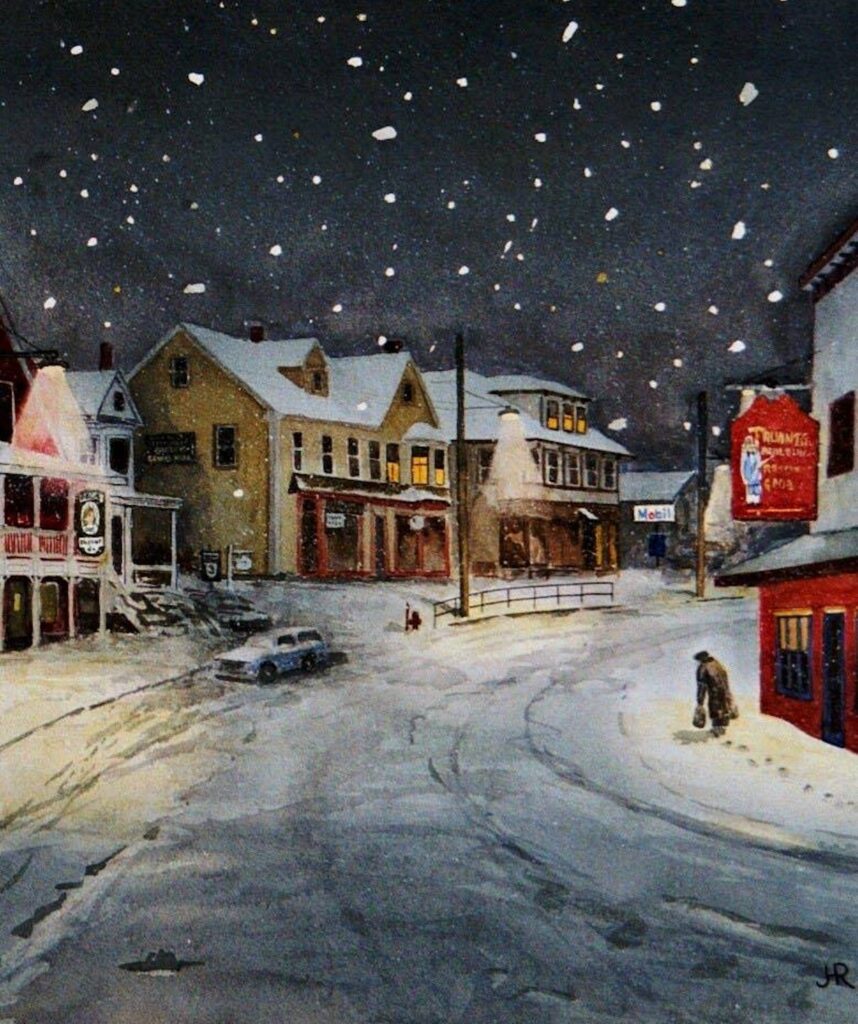
“Anna’s Quest,” by Jack Richardson
On a snowy day in North Woodstock, a solitary figure makes her way along Main Street, bundled against the winter air, her footsteps purposeful and familiar. This is the scene captured in Anna’s Quest, a cherished painting by local artist Jack Richardson (1938–2017), and the figure at its center is Anna Marie Molloy (1909–1996) — a woman whose presence, pride, and devotion to her hometown left an imprint still felt today.
Anna was one of those rare community figures whose daily rhythms became part of the town’s landscape. People remember her steady stride along Main Street, her unwavering interest in local happenings, and her instinctive sense of Woodstock’s history. After her passing in 1996, friends and neighbors sought a way to honor her life. Richardson, who had worked with Anna years earlier at the old Hotel Alpine, felt compelled to commemorate her memory in a way that captured not just her likeness, but her spirit. The result was Anna’s Quest, a wintry streetscape with Anna moving through fresh snow — a symbol of both her literal walk through town and her lifelong quest to understand, record, and uplift the place she called home.
Richardson created prints of the painting, and the proceeds supported the creation of the Anna Molloy Memorial Fund. One of the fund’s first tangible projects was the purchase of a bench for Soldier’s Park, where visitors can pause and look back toward the heart of Main Street. The bench remains a quiet reminder of someone who spent decades walking those same streets, observing its changes, and preserving its stories.
Because Anna was more than a familiar face—she was also one of Woodstock’s historians. In 1963, during the town’s bicentennial celebrations, she contributed to Woodstock Celebrates 200 Years, 1763–1963, a booklet of local history and legend published by Glen Press. Her name appears on numerous historical captions from that period, often signed “Historian,” where she documented details about the North Woodstock Electric Plant, Russell Pond landmarks, and the early character of village life. These brief pieces, scattered through archives and community collections, show a writer with a deep appreciation for the stories embedded in everyday places.
Longtime Woodstock historian, Barbara Avery, remembers Anna not only as a chronicler of the town’s history but also as a character in her own right. While serving as the town librarian in the early 1980s, Barbara recalls Anna selecting a book and then flatly refusing to sign the checkout card—insisting that of course she would return it. “She absolutely refused to sign the card and she was very angry with me,” Barbara recalls. Years later, however, Anna more than forgave the incident. For the Fourth of July in 1992, she crafted a handmade bookmark for Barbara decorated with her familiar sayings: “Turn your motor off when idling, it taint the air and violates the law,” “Please don’t litter the road,” “Plant the apple seed in the forest for the deer and keep it green” (complete with an apple seed taped to the card), and “the White Mountains pure.” She signed it with her characteristic flourish: “Merci – Thank you – Mahalo.” Barbara still treasures the card today.
Local memory also recalls Anna making her rounds through town to gather news for a weekly column or community report in the Plymouth Record, one of the region’s small-town newspapers. Elders remember her knocking on doors, checking in at village shops, and chatting with neighbors to make sure every wedding, visit, achievement, or quiet event found its way into print. Though surviving issues of the Record have not yet been fully digitized, the recollections are vivid: Anna as a roving correspondent, carrying Woodstock’s news beyond its borders, ensuring that no small moment went unnoticed.
When viewed in this light—as historian, writer, neighbor, chronicler, and daily walker—the title Anna’s Quest feels especially fitting. Her “quest” was not grandiose or dramatic. It was steady, humble, and profoundly important: to keep the memory of a small New Hampshire town alive, to notice its details, and to share them with others. Richardson’s painting captures a single moment of that quest, but the deeper story lies in the decades she spent listening, observing, and recording the life around her.
Today, the painting, the memorial fund, and the bench in Soldier’s Park form a small constellation of remembrance. They tie Anna’s story to the physical places she loved and to the community she helped document. When visitors sit on that bench and glance toward Main Street—especially on a snowy day—they are sharing a view Anna knew intimately. It is not difficult to imagine her walking there still, coat buttoned tight, eyes alert for whatever story the day would bring.
In honoring Anna Marie Molloy, we honor not only a beloved resident but also the quiet work of memory-keepers everywhere—those who preserve the texture of local life so that the identity of a place, and the people within it, are never lost to time.
Author’s Note:
This article is part of the Upper Pemigewasset Historical Society’s ongoing effort to preserve and share the stories of the people who shaped the cultural life of Lincoln and Woodstock. Much of what we know about Anna Marie Molloy’s work comes from community memory, historical research, and scattered archival materials from local collections. As we continue to build a more complete picture of Anna’s contributions as a writer and historian, we welcome help from anyone who may have additional materials, clippings, or recollections to share.
Help Us Preserve Anna’s Story
Do you have old issues of the Plymouth Record tucked away in your home, attic, or family scrapbooks? Did a parent or grandparent save local newspaper clippings featuring Anna’s Woodstock news reports? The Upper Pemigewasset Historical Society is currently gathering materials related to Anna Marie Molloy’s writing and historical work.
If you find newspaper clippings, photographs, or other items connected to Anna, we would love to see them. You can bring them to the museum during open hours in the summer or make an appointment with us, email us scans, or allow us to digitize them and return the originals to you. Every small contribution helps preserve our community’s collective memory — and ensures that Anna’s legacy, as both writer and neighbor, continues to be shared with future generations.
Contact: uphsnh@gmail.com
Mailing Address: Upper Pemigewasset Historical Society – PO Box 863 – Lincoln, NH 03251

