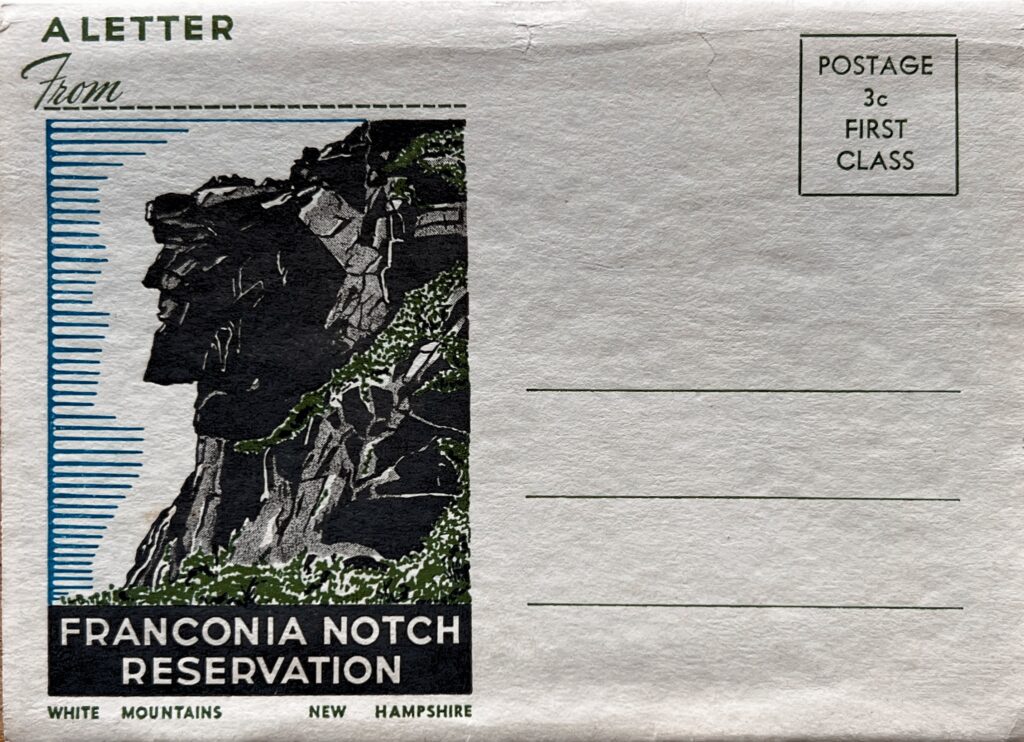
Franconia Notch Reservation: A Letter
By Richard Bennett Talcott (Franconia Notch Reservation—White Mountains, New Hampshire, 1949)
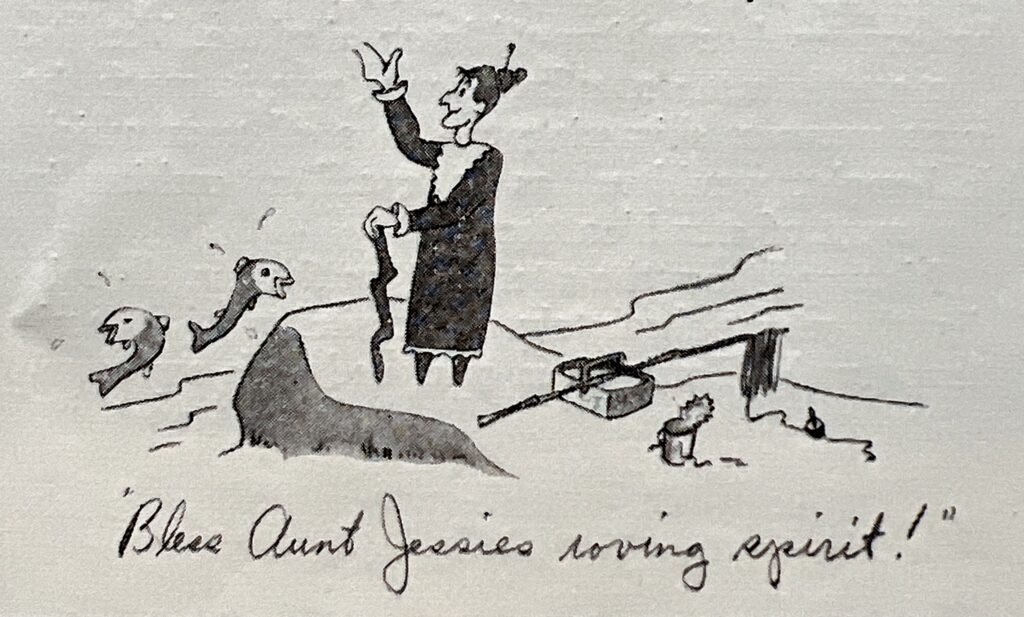
Millions of anglers will fish ’til the end of their days and never be as lucky as Aunt Jess Guernsey.
And it’s my guess that of the millions, few will still be fishing when they get to be as old as Aunt Jess was on the day she made her great find. She was ninety-three when, in search of better waters, she discovered the wonderful Flume Gorge.
I heard about the remarkable little old lady today when I walked along the floor of the chasm and looked up in wonder at the foliage which forms an arch at the top of its perpendicular granite walls, some seventy feet above.
The story, however, was but one of many fascinating tales I heard when I visited the six thousand-acre Franconia Notch Reservation, way up here in the heart of New Hampshire’s White Mountains, where I’ve had such a grand time that I thought I’d drop you a line and tell you about it.
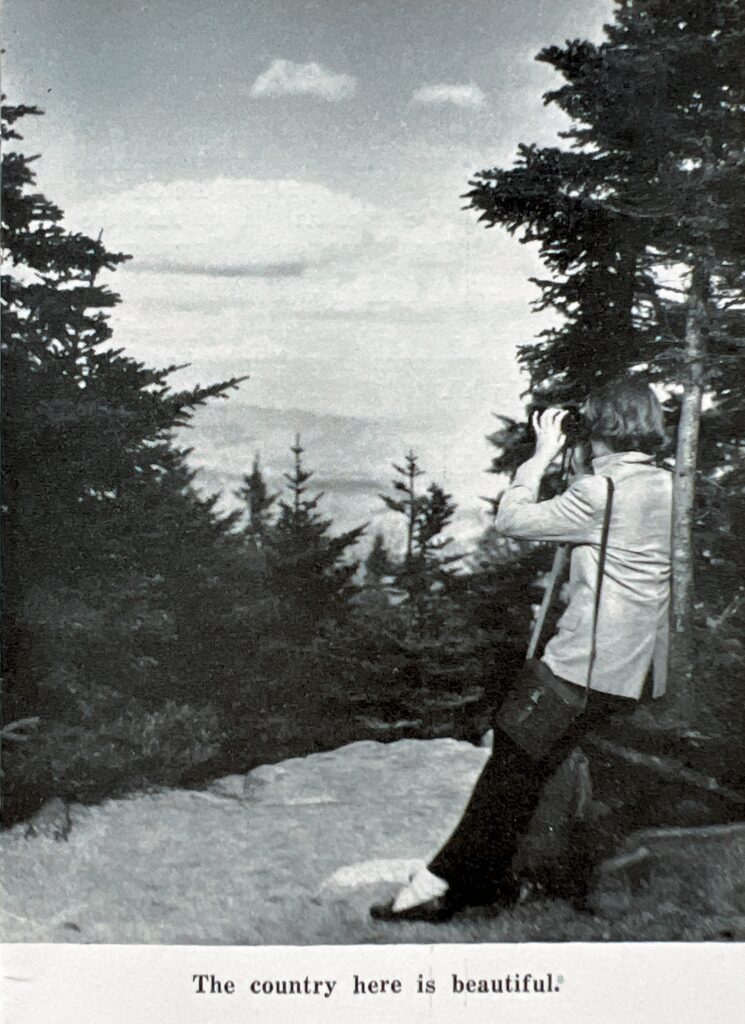
In addition to visiting the Gorge, which is in the Reservation, I rode to the top of Cannon Mountain on the Aerial Tramway to be rewarded with one of the most magnificent views I have ever seen. I was awed by the majesty of the great stone face as I gazed upon its features from the shore of Profile Lake. I heard the story of the great landslide of 1948 when I surveyed from a distance the ugly scar it left on the side of a mountain. To top it all off, I dallied for awhile by the side of Echo Lake to watch a skillful angler land one of the nicest trout I’ve seen in many a moon.
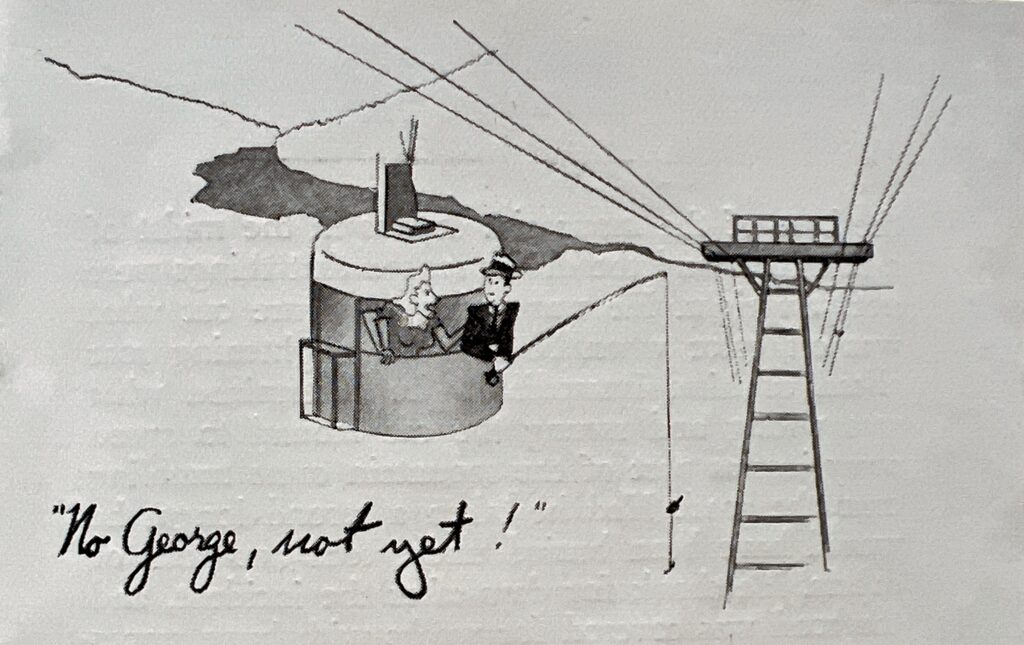
My adventures here began when I took a trip on the Aerial Tramway, which lifted me and several other passengers up two thousand feet as effortlessly as it later took us down.
It’s a little difficult to describe the sensation of such a journey, for I’ve never had any quite like it before. We rose so silently that it could hardly be compared to taking off in an airplane. Yet, the two are, in a sense, alike, for we rose in much the same manner, skimming the tops of trees which, I thought, would act as an excellent cushion in the event of a sudden drop.
I learned from the attendant on the car, though, that there was absolutely no possibility of an accident, for the Tramway is equipped with any number of safety devices. Though normally operated from its starting point at the bottom, the car can be controlled by the attendant in it. And the operator at the bottom is surrounded by automatic devices that will stop everything in the event that something should happen to him.
Why, there’s even an auxiliary power supply that can be drawn upon immediately should the normal supply fail.
Pretty clever, these guys, hey? The cleverest part of the whole set-up, I thought, is the way they let the downcoming car pull the other one up.
* * * * *
How would you like to be able to peek into Canada, get a good look at Vermont, see way beyond it into New York state, and at the same time gaze over the border into Maine and then, simply by turning a little, look down your nose at staid old Massachusetts?
That’s just about what I did when I reached the top of Cannon Mountain, where our group was greeted by a friendly guide who took us around the rim of the summit and told us about the surrounding ranges.
Immediately after welcoming us, our guide took us over a pleasant wood path that led through a stand of fir balsam whose trees are three feet eight inches at the base. They are more than seventy-five years old, he told us. (Quite a fellow, our guide. He knew all about the plants and trees here and passed the information on to us.)
Suddenly, the path came to an opening and there before us was a breath-taking view of Mount LaFayette with Profile Mountain somewhat nearer. It was here that I got a good look at the sand colored scar that streaks down the side of LaFayette. It was caused by the landslide in the spring of 1948 and is 50 or 60 feet deep, although from here it seemed but a scratch on the surface.
We listened intently as our guide told us about another guide who was driving along the road at the base of the mountain. It was in the midst of a rainstorm, and the driver sensed that things were not just right. He was trying to figure out what was off color when he heard a frightening roar ahead of him. Immediately, he determined what was wrong and swung the car around to speed away just as part of the mountain came tumbling onto the road. Had he taken a second longer, he would have been buried under tons and tons of debris. He shook for days after the incident, and the road was covered for weeks with huge stones and gravel. ‘Tweren’t fun!
From this vantage point, we were able to get an excellent view of the Presidential Range, whose peaks scraped the distant horizon. We also saw the Sandwich, Pleny, Green Mountain, and Franconia ranges.
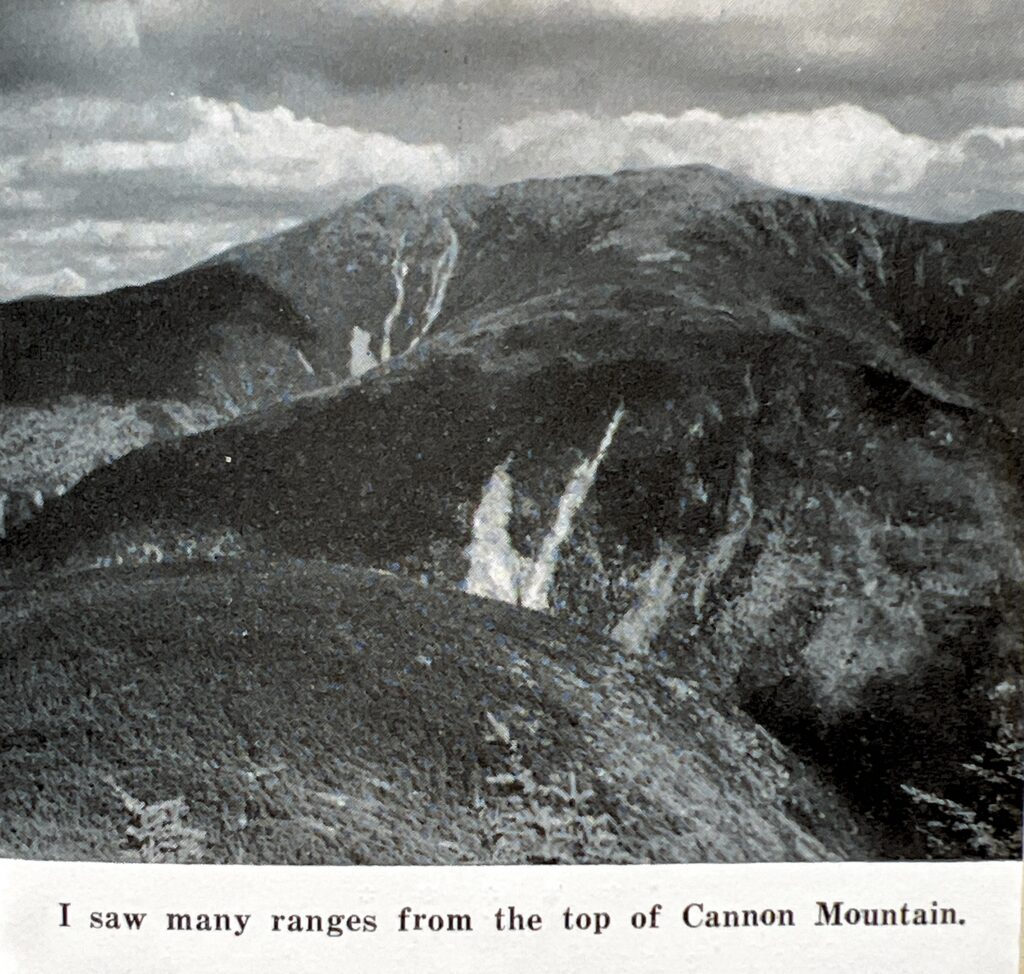
At another point on our trip, we stood on the edge of a precipice that dropped many hundreds of feet to the rocks below and watched as the guide showed us George Washington lying in state. It was at the same point he told us about how we could see from the main highway below the cannon that gave this mountain its name.
As we followed our guide, we noticed picnic tables in pleasant groves and were informed that many people come up here to spend the day and eat picnic lunches. That sounds like a wonderful idea to me. I don’t think I’d ever tire of the views from this spot.
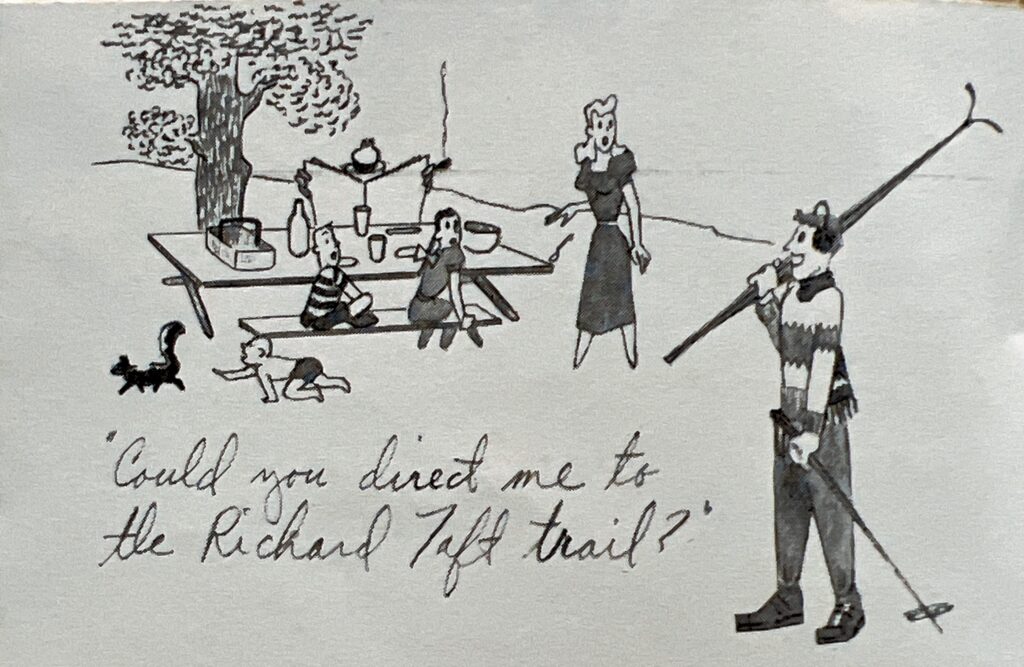
In the course of our journey, we saw the Green Mountains of Vermont, the Sutton Range in Canada, and Blue Moose Mountain in Maine. We also saw some of the ski trails that are cut through the forest on the side of Cannon Mountain. One, the Richard Taft Trail, is about the toughest in the country, and the National Ski Races were held here in 1946. It is more than a mile long and drops 2,300 feet. Bub, the beginner’s trails (slopes, they call them) look mighty scary to me, let alone the Taft Trail.
Back in the station, I sat for awhile to sip a Coke as I looked out the wide panorama windows at the scene below and at the Tramway cars going up and down the side of the mountain. It was with some reluctance that I boarded the car for the journey down. Other interesting experiences still awaited me, however.
* * * * *
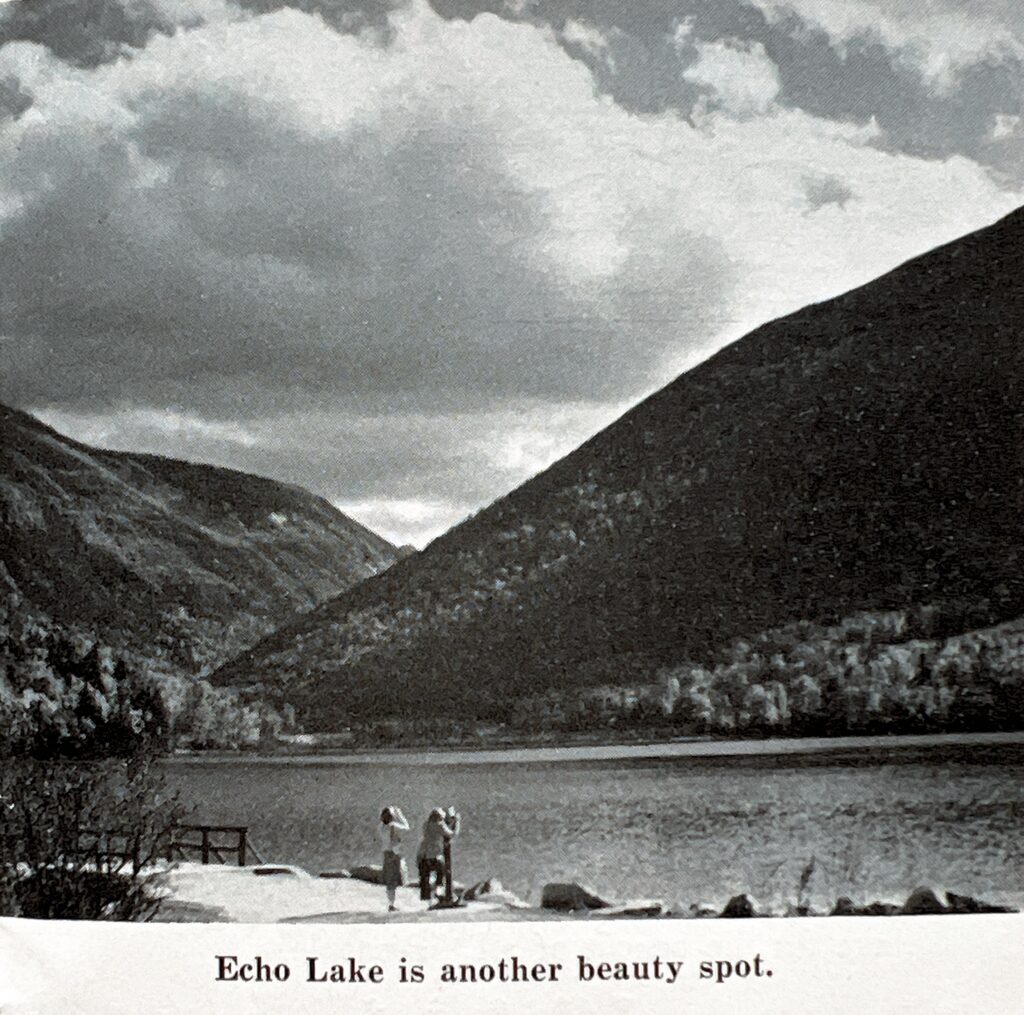
Echo Lake is a pretty little body of water at the head of the Reservation. I reached it easily in the car and climbed Artist’s Bluff to look down through the entire Notch. I just can’t describe the beauty of the view. You’ll have to see it yourself to really appreciate it.
As I stood by the sandy beach (there’s wonderful swimming here), I couldn’t resist that temptation to give a lusty shout. Sure enough, my voice echoed and re-echoed from surrounding mountains.
Before I left, I read a plaque that is mounted on a tablet here in memory of Philip Wheelock Ayers, who was one of the leaders in the establishment of the White Mountain National Forest and the Franconia Notch Reservation.
* * * * *
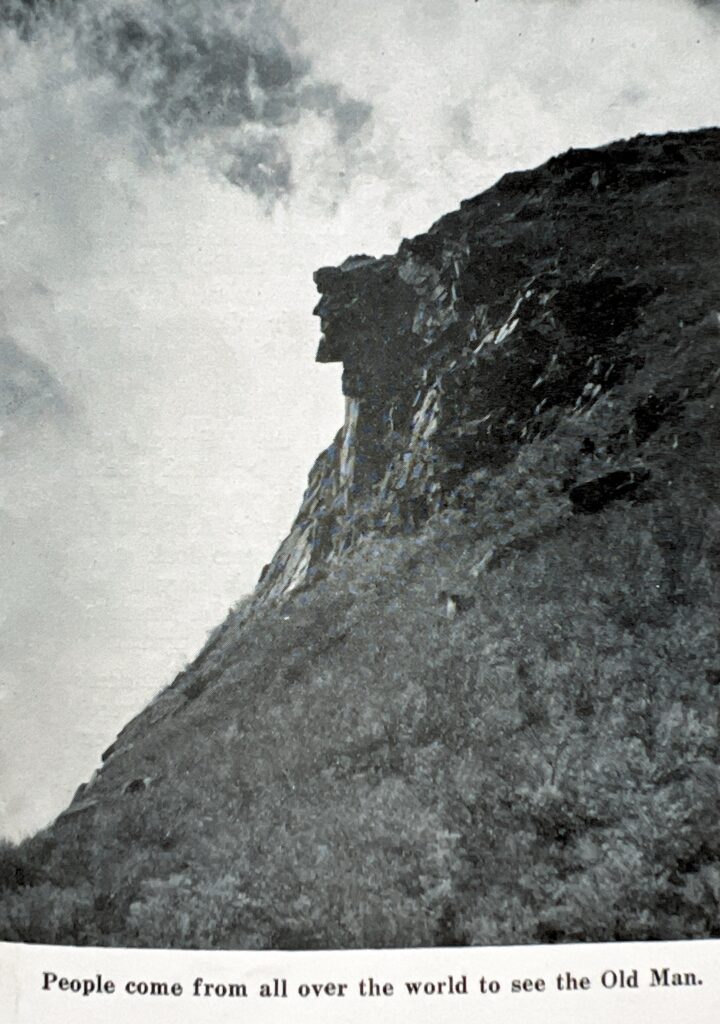
You’ve undoubtedly read the “Great Stone Face” by Nathanial Hawthorne, but until you’ve seen it outlined against the sky, you can’t begin to realize how wonderful it really is. People come here from all over the world just to look at its features. I got my best view of it after I had walked over a little woods path to the shores of Profile Lake, whose waters are clear as crystal.
The head has probably been here for hundreds of thousands of years, but it wasn’t discovered until along about 1805, when a couple of surveyors happened to notice it.
On my way to the lake, I had stopped in one of the several gift shops that are thoughtfully placed in convenient locations throughout the Reservation. I made several purchases from the stocks of excellent souvenirs that are so attractively displayed.
I stopped for awhile outside its door to look at the wishing well that is there and to listen to a little of the story behind the Reservation. It is dedicated to the memory of the men who were lost in all wars. The children of New Hampshire helped purchase the Reservation with their donations. It was dedicated in September, 1928. The best part of it all is that the money derived from the operation of the tramway and the gift shops is plowed right back into improving the facilities here for the benefit of all the people.
* * * * *
Like everybody else, I was anxious to get to the famous Flume as quickly as possible and tour the place about which I had heard so much. Inviting paths along my route, however, bade me to several side adventures. One of these led to the LaFayette Campground, where I lingered to look at the beautiful log ledge that is the area’s recreation center. In it is a huge fireplace around which campers gather to while away evenings singing and telling tall tales.
Seems you can pitch a tent or park a trailer here for a very small fee. From what I hear, campers at this site have the time of their lives.
Another path that beckoned led me by the basin with the old man’s foot and along a mountain brook with myriad waterfalls. Here, water races over the solid rock bed that has been worn smooth by its action.
* * * * *
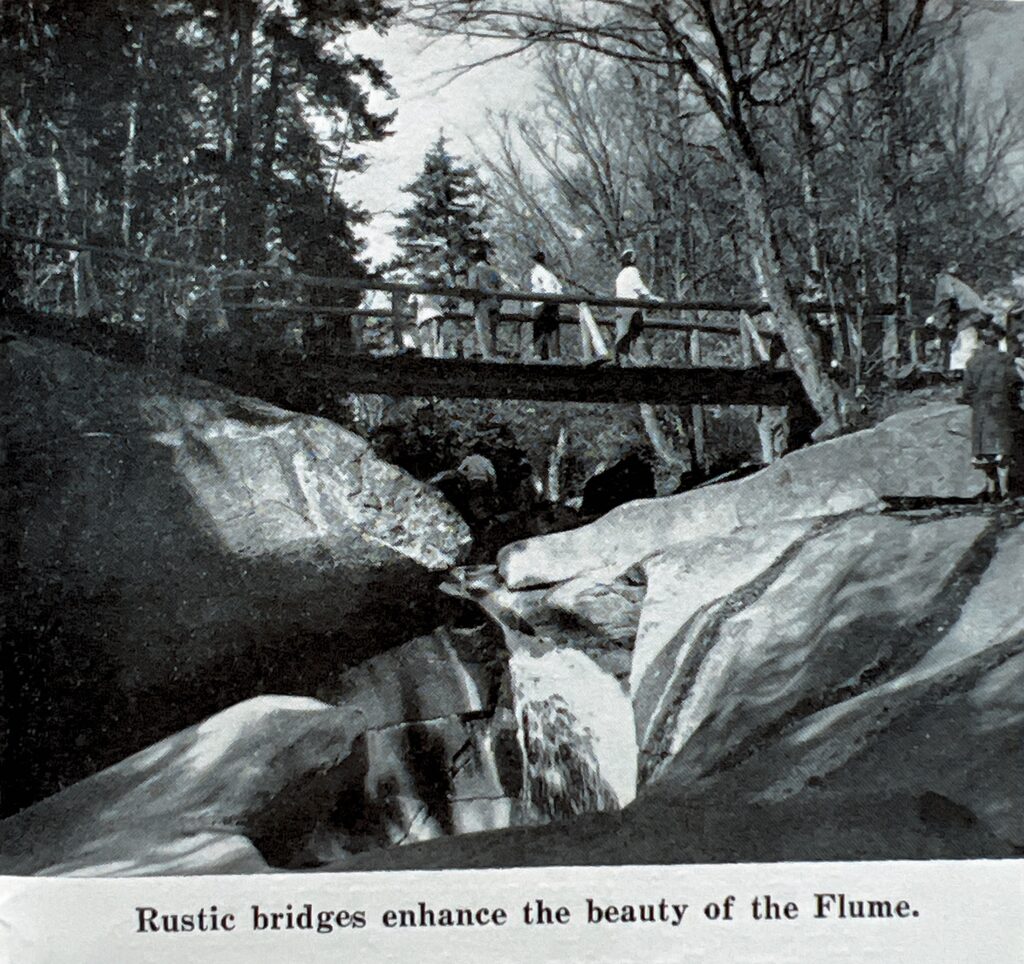
Friends of Aunt Jess Guernsey thought her a little “teched,” I guess, because she liked to fish so much. Despite her “affliction,” however, she had enough sense to commercialize her find and reap a small fortune during the remaining years of her life.
The State of New Hampshire has eliminated all commercial aspects from this natural wonder. It has, however, made it easily accessible to the public by putting board walks along the sides of the Flume and in some cases along its bed.
Did I say the state made it easily accessible? Well, now, I’m going to take back part of that remark, for I was really leg weary after I had climbed the steep paths and made the circle of a mile or more to round the rim of the Gorge. It was worth every single step of it, though. As a matter of fact, so breath-taking was the spectacle that I didn’t realize I was getting tired until I had returned to the car.
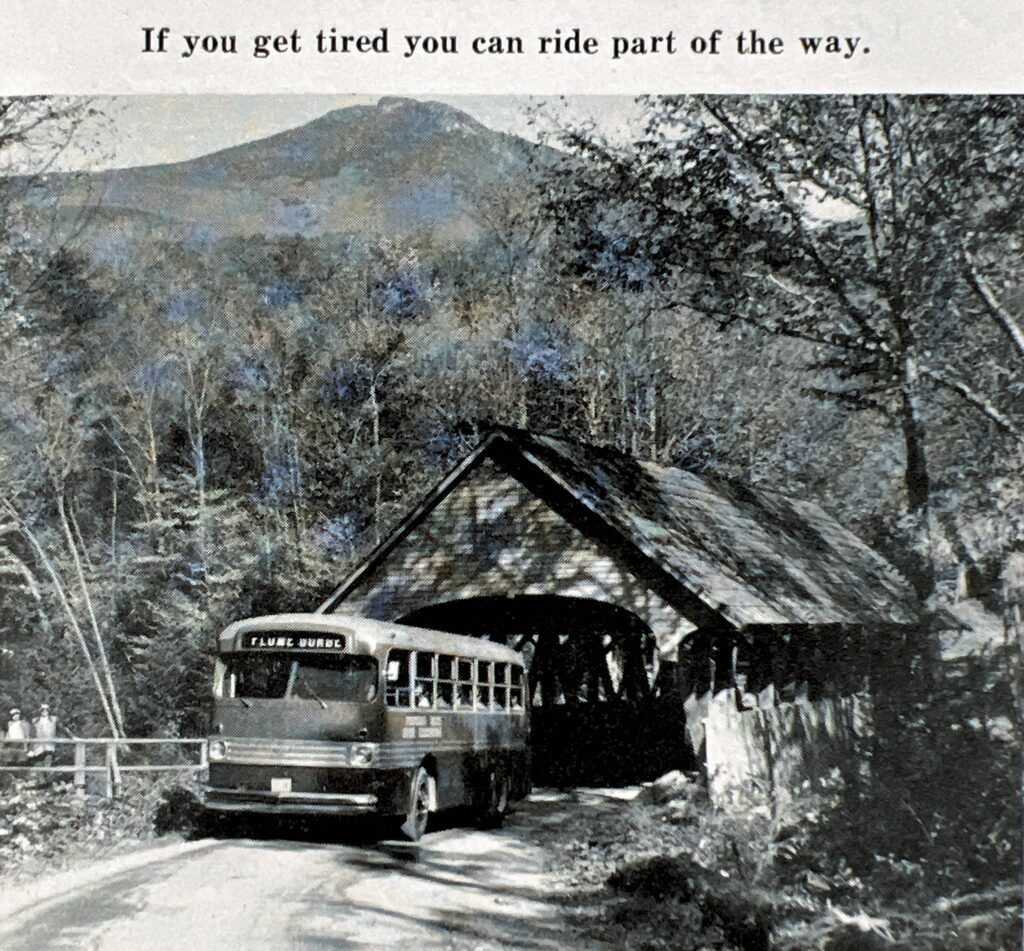
The visit to the Flume was a fitting climax to my stay in Franconia Notch, for seldom have I been so impressed. The Gorge was formed many millions of years ago, but man has done a few things to enhance its beauty—the covered bridge with which he arched the stream and the rustic benches he placed along the paths are only a couple. But if I tell you much more about it, your visit won’t be quite as enjoyable when you come here. You have to make some discoveries for yourself, you know.
So—put on your hiking shoes, check your tires, and head for Franconia Notch just as soon as you can. You’ll have a wonderful time, too, just as I did.
P.S. If you’re a little lazy and don’t want to walk, there’s a bus that will take you part way to the Flume. Don’t tell anybody, but I broke down and rode back to the Flume Tea House.
NOTES
- Talcott, Richard Bennett. Franconia Notch Reservation—White Mountains, New Hampshire. Boston, MA: The Letter-Booklet, 1949. Upper Pemigewasset Historical Society Collection.

