The Weeks Act—A 75th Anniversary Appraisal
By The Honorable Sherman Adams (1986 speech)
Fellow members of Newcomen and guests:
We are here today to celebrate the seventy-fifth anniversary of the Weeks Act and its offspring in New Hampshire, the White Mountain National Forest. It is, in every sense of the word, a people’s forest. It came about because private enterprise, nonprofit organizations and government employees worked in concert to save the White Mountains. The Weeks Act of 1911 was prescient; it recognized this area as a national treasure, one held in delicate balance by diverse groups of local, state, regional and national interests. We are here, therefore, to praise that foresight and balance. Yet in recognition of recent disagreement, we are also here to restore harmony—the kind of harmony so much in evidence seventy-five years ago.
The forests of New Hampshire have always had recognizable value, but only in the past hundred years or so have we been able to articulate that value and recognize its full potential. The real “father” of New Hampshire forestry was Concord’s Joseph B. Walker. A lawyer by training, Walker spent the last three decades of the 19th century championing such causes as better care for the insane, “scientific” agriculture and good forestry.
Throughout the 1870s, Walker traveled the state, urging local farmers to take better care of their woodlots. Not only were trees a valuable “crop,” but they protected the soil. In 1883, as a member of New Hampshire’s first forestry commission, Walker gave the keynote address at the annual meeting of the New Hampshire Fish and Game League. By this time, his thinking on the subject of forestry had matured and moved beyond the farm. Walker was convinced that New Hampshire’s entire environment—its soil, water and air—depended upon good forests. Beyond aesthetics, Walker stressed the economic advantages of good forests. Cut timber was only one of the advantages; good forests also attracted tourists and sportsmen.
Walker led a small group of citizens concerned for the welfare and future of New Hampshire forests. Rising property taxes, destructive fires and the sale of large tracts of state-owned forest land in the White Mountains were some of the threats. Bad forestry was another. To preserve New Hampshire’s forests, Walker continued to appeal to the better instincts of private landowners. Yet by 1886, he realized something more was needed. He urged that the State of New Hampshire get into the act by conducting a survey of its forests, passing tougher laws to prevent forest fires, considering tax relief for timberland owners, and finally, purchasing forest reserves.
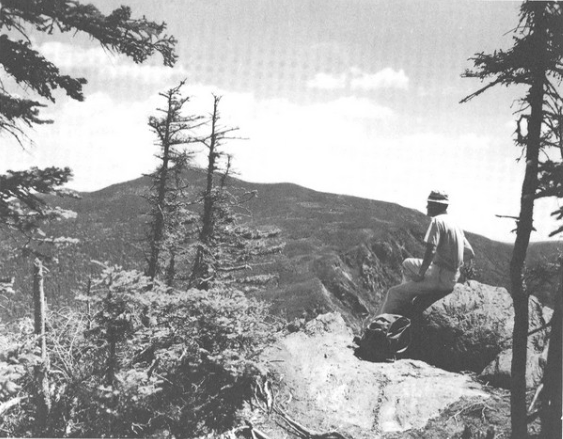
The White Mountains…a national treasure…over five million people visit the White Mountain National Forest each year. As our population grows and cities spread out, the national forests become the foremost attraction for our outdoor pursuits.
If Joseph B. Walker was responsible for sounding the alarm, it was Philip W. Ayres and John W. Weeks who led the charge, culminating in the passage of the Weeks Act a quarter of a century later in 1911.
The effort to “save” New Hampshire forests had many dimensions, but the man who transcended them all was Philip Ayres. A historian by training and a social worker by experience, Ayres was hired as chief executive officer of the Society for the Protection of New Hampshire Forests in 1902. The organization was only a year old. In spite of its broad base of membership, however, the Forest Society had started off badly. It hoped to save New Hampshire’s forests through an ambitious offering of academic and sentimental arguments (the Boston Transcript said of the early SPNHF campaign: “It roars too much of the sucking-dove tone”). Ayres changed all that. He not only created an appealing educational program, but he gave the Forest Society sharp focus by campaigning for a federal reserve in the White Mountains.
The idea of creating a federal forest reserve was not radical—there had been federal forest reserves in the West since 1891—but the idea of purchasing private lands to create a reserve in the East was controversial. Efforts to create a federal reserve in the southern Appalachians had begun in the 1880s, but by 1900, the local efforts had largely disintegrated. What remained was in the hands of U.S. Chief Forester Gifford Pinchot, but his attempts to win federal approval for a federal reserve in the southern Appalachians met with failure.
Philip Ayres had studied the southern campaign. Whereas the southern effort had suffered from political ineptitude and broad support, Ayres put together a politically astute plan. He assembled a coalition made up of diverse elements—loggers and pulp manufacturers, nature lovers, hotel owners, political leaders, literary figures and just about anyone else who could see the economic and environmental advantages to saving the White Mountains. Groups like the Appalachian Mountain Club, the New Hampshire Federation of Women’s Clubs, the Massachusetts Forestry Association and the New Hampshire Grange joined the fight as well. Finally, Ayres rose above the early objections of Gifford Pinchot and joined the effort to save the White Mountains with that to save the southern Appalachians. Ayres argued that the White Mountains were a national treasure, and as such, should be protected by federal law. An individual state like New Hampshire might purchase smaller state parks. Only the federal government had the resources to purchase and manage whole mountain ranges.
Had Massachusetts Congressman and New Hampshire native John W. Weeks not entered the picture, the legislative history of the Weeks Act might well have been “a tale full of sound and fury, signifying nothing.” Between 1903 and 1909, there were repeated futile attempts to get a northeastern reserve through Congress. The main obstacle was Speaker Joe Cannon, bolstered by objections from congressmen representing other parts of the country claiming that it was a state, not a federal, issue. Even the nature of the legislation changed. In order to broaden the economic impact of the proposed reserve, and to override constitutional objections, proponents switched from “timber” to water,” claiming that the proposed reserve would insure the “navigability” of navigable waterways.
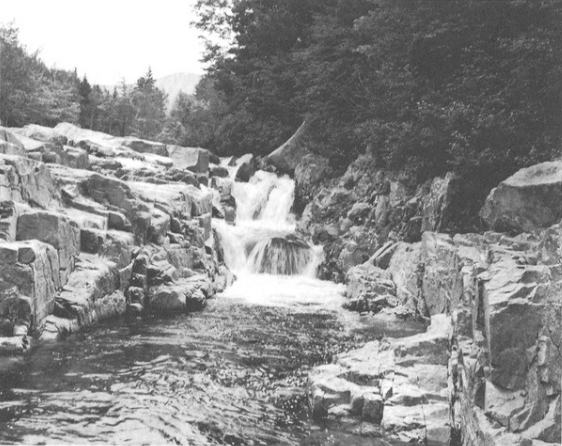
Headwaters of navigable waterways…the eastern national forests were created to help protect the headwaters of our rivers and streams. The Saco, the Ammonoosuc, the Merrimack, and the Connecticut are all nurtured in part in the protective confines of the national forest.
In 1908, Speaker Cannon surprised everyone by placing John W. Weeks on the all-important House Committee on Agriculture. Weeks was a businessman, and Cannon respected him. In spite of opposition from the Corps of Engineers and the Weather Bureau, Weeks came out in favor of forest reserves in the East. His now-famous bill was introduced on July 23, 1909, and was signed into law by President Taft on March 1, 1911. The Weeks Act called for state-federal legislation in fighting fires, and it allowed for other forest reserves outside of the White Mountains and southern Appalachians. A combination of businesses, nonprofit organizations, concerned citizens, and public officials had made it possible.
That the Weeks Act was an outstanding achievement in national forest conservation policy is axiomatic. But it was both, and more and less than that. Less, in the sense that it was quite narrow in its national scope. Its impact was restricted to the headwaters of navigable waterways (which happened to be just fine in New Hampshire but not very helpful in many other areas of the country). This limiting aspect of the legislation was the result of necessary political compromise and some assumed constitutional obstacles.
And it was much more. More even than the description given it in a 1936 Journal of Forestry editorial: “…the principal landmark on the pathway of natural progress in forestry.”
As the highest summit of these white hills, Mt. Washington stands proudly and permanently above its companions. So the Weeks Act, at the Silver Jubilee celebration held in this very room on September 13, 1936, was seen standing like a giant peak, surrounded by the lesser hills of other conservation legislation.
Its lofty stature derives from two critical elements of its evolution; two factors which were essential to its passage and successful implementation. I will return to these in conclusion when I look ahead to the 100th anniversary celebration.
First, the act was ultimately, and in the finest sense, a people’s proposition. It was not born of the U.S. Forest Service or Gifford Pinchot or Philip Ayres and his Society. It was rather a coalescence of the public interest in natural resource protection and management, the public concern over forest depletion, and the public appreciation for the unique array of goods and services which emanate from the forest.
It was the first measure of a nation passing beyond the frontier attitude that the only forest land necessary to protect was that already in the public domain. It signified, in a maturing nation, a public recognition that all forest land, even that in private ownership, contributed to the public good and was worthy of the application thereto of newly defined principles of conservation.
The second essential element was the vision of the act’s supporters of a “working forest.” They, especially the New Englanders, recognized that the new national forests must fit within, and must complement, the existing mosaic of land uses. This meant from the very start that the forests must be managed under what we now term “multiple use” principles. Recreation, timber production, soil, water and wildlife protection and enhancement—all have their rightful place and all must be considered in management decisions.
It was this mix of uses that initially garnered and continued to hold together the broad coalition of individuals and interest groups without whose support the eastern national forest system would never have become a reality.
No discussion of multiple uses would be complete without mention of recreation—a use that has had a profound influence on every other use and user.
Outdoor recreation in these hills had its origins some ninety years prior to the enactment of the Weeks Act by way of the slow development of bridle paths to various summits, later becoming foot trails or routes for other means of locomotion, such as the Mt. Washington Carriage Road and, later, the Cog Railway.
By 1936, footpaths had been extended throughout the forest by enterprising hiking organizations, the Appalachian Mountain Club being the oldest and largest, and by the Civilian Conservation Corps program which had established a number of camps throughout the forest. The young men of the CCC were busily building new trails and Adirondack shelters, constructing picnic areas and campgrounds, and clearing ski trails.
The AMC, under the leadership of Joe Dodge, its legendary huts manager in Pinkham Notch, had completed a system of mountain shelters by 1932. Thus the CCC and the AMC combined had opened up the more remote areas of the White Mountains to hiking and camping, all this a prelude for things to come.
The 50th Anniversary of the Weeks Act coincided with the recreation explosion which had been building through the 1950s. The facilities constructed in the ’30s, idled during World War II, now provided the framework upon which this growth found place and nourishment. The Outdoor Recreation Resources Review Commission’s Report in 1958 made dramatic and potent recommendations for the future. Congress acted by establishing the Land and Water Conservation Fund and the Bureau of Outdoor Recreation.
State and national forests and parks benefited from comprehensive planning efforts, and then qualified for capital funds to expand existing facilities and create new ones. The WMNF benefited from enlarged recreation budgets, resulting in improved campgrounds, trails, forest roads and picnic areas.
Meanwhile, the AMC had not been idle and had established a huts construction committee to plan and oversee an improvement and expansion program. The summer of 1961, coincident with the issuance of a National Geographic Magazine story about the hut system by Justice William O. Douglas, proved to be the busiest summer in the history of the huts.
All over the forest, recreation pursuits were intensifying, from the new-to-the-scene snowmobile trailriders to the technical climbers on rock and ice. With the completion of the Kancamagus highway in 1959, non-hikers could view the heart of the WMNF by traversing the thirty-four-mile highway between Conway and Lincoln, thus opening up this hitherto wild area to greater numbers of the public.
At the fiftieth anniversary of the Weeks Act, the WMNF was feeling the increasing impact of recreationists on a year-round basis. Forest administrators, cooperators and users all, were well aware that the rush was just beginning; the question was, how great will be the crush of recreationists in the years ahead and what will be the land use and management consequence?
Pride and confidence set the tone and substance of the fiftieth anniversary celebration held at the Crawford House in 1961. The coalition of interests that had supported the forest and its steward, the U.S. Forest Service, for five decades was strong and building with the involvement now of new groups—Audubon Society of New Hampshire, snowmobilers and others. Earlier, Forest Supervisor Clifford Graham, recognizing the growing potential for conflict along with the increasing numbers of groups with a role to play in forest planning, had established a formal citizens’ advisory committee.
And if the burgeoning recreational use, coupled with the traditional lumbering and other activities, were the only issues that had to be resolved, the next twenty-five years could have gone as smoothly as the atmosphere at the Crawford House would have predicted.
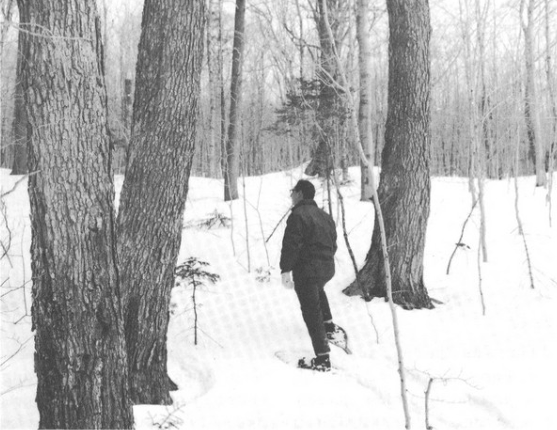
…hundreds of thousands of acres of forests reaching maturity…the White Mountain forests are once again growing white birch, sugar maple, spruce, fir, ash and white pine; productive forests for industry and the millions who come to see the lush greenery and vibrant fall colors.
But this was not to be. For quietly, without public debate, the U.S. Forest Service adopted evenaged silviculture with clearcutting as its principal means of harvesting throughout the country. This occurred almost simultaneously with the Crawford House celebration. After decades of using locally-modified selective and selection cutting programs, the Forest Service had by 1962 incorporated in a wholesale, indiscriminate manner this aesthetically disruptive and, in forest conditions such as those prevalent in the White Mountains, scientifically questionable system.
Throughout most of the following semi-quinquennial, the Forest Service ignored the carefully but over-cautiously couched findings of its own research staff. They had determined in experiment after experiment that desirable silvicultural results in northern hardwoods could be obtained through individual and group selection systems. Perhaps even worse, the Forest Service ignored the public displeasure over clearcuts on scenic slopes and along highly visible trails and roadways. Strong criticism of clearcutting was heard from traditional friends including the SPNHF but the bureaucratic momentum was too great. Regional or local differences would not be accommodated.
This myopic mission, with all its misuses and abuses, was justified because it was cheaper and easier to control and administer. In their defense, the Forest Service had just been through several years of tight-budgeting for timber sales preparations. Funds for silvicultural niceties were virtually impossible to come by. They were, in addition, dealing with a forest that had been shaped by the poor harvesting practices of the past. Thus, the conclusion that clearcutting and starting all over again with a fresh forest was appealing.
Nevertheless, the net result was clearcutting. In the eyes of many, the only difference between the logging practices of the 1890s and the current version was the increased efficiency of the modern heavy machinery.
Thus, for the first time since 1911, the public confidence in the U.S. Forest Service was seriously shaken. After decades of exhibiting their outstanding professionalism and integrity of purpose to the tenets of forest conservation that all its friends could share, the Forest Service staff was forced into defending the indefensible. Because of an ill-advised national edict the very qualities we had long admired (and still do) of steadfastness and loyalty caused a friction between the service and its natural allies.
The direct consequence of this on the White Mountains and elsewhere was an alienation of affection. The movement for a national wilderness system gained congressional approval in 1964. This legislation was both timely and appropriate. Unfortunately it was aided in its passage and subsequently pressed into implementation by those who saw wilderness designation as the only certain means by which their favorite niche of a national forest could be protected against the very public agency that had been assigned to guard and manage it.
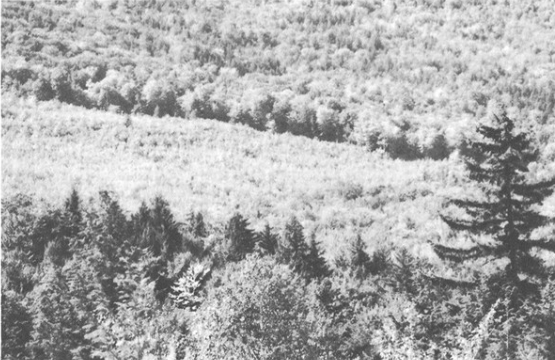
Clearcutting was a principle means of harvesting…today the timber harvest is done with a number of objectives, including the protection and enhancement of scenery, wildlife habitat and the growth of high quality trees. Various silvicultural techniques are used.
I suspect (or at least hope) there is not one person in this room who does not share my belief that we must have wildness (with a lower case “w” in Thoreau’s meaning when he said “In wildness is the preservation of the world”) as well as Wilderness (with a capital “W” as in the congressional designated Wilderness with its prohibition against many bureaucratically-enumerated nonconforming uses including timber harvesting and recreation for anyone but the physically unimpaired). But I trust that most of you will also share my concern that the heavy-handed big “W” wilderness may be overused and abused. Especially in New England, where we have both the tradition of multiple use and the pressure of nearly one-fifth of the nation’s population on less than 5 percent of the nation’s land mass, we need to make this meager land base accommodate the optimum variety of uses. The European experience serves as a fine example. They have been able to adapt their silviculture and their land management to a socio-environmental ethic that transcends the artificial reliance on big “W” designation. I will shortly propose the silvicultural part of the solution that will lead to such a Nirvana.
While the public’s dissatisfaction and old-time friend’s disappointment over insensitive silviculture highlight the disturbing threat to our New England tradition of consensus building among users of the White Mountains, the danger to the forest has other roots as well. Using a large tract of public land as an ideological battleground and the dedicated professional public servants who manage it as whipping boys is a reflection of a national trend toward divisiveness in public debates brought about by special purpose groups with single-minded goals. The carefully forged White Mountain Wilderness Compromise of 1984 was prepared by a broad coalition of New England organizations and interests. It was nearly torn apart when Washington groups, led by The Wilderness Society, unrelentingly attacked the legislation. Fortunately, the narrow interest dissidents lost out, but not before local organizations (principally SPNHF and AMC) spent tens of thousands of dollars in countering their tactics and propaganda. Locally, where once a handful of parties could hammer out a consensus position, the list of special interest private groups, public bodies and individuals involved in White Mountain affairs now runs into the hundreds.
In the early days of this century there were strong ties between the political and economic decision-makers in New Hampshire and Massachusetts. These alliances helped immensely to bring about both the Weeks Act and the many subsequent legislative measures that expanded and improved it. Now primarily the AMC, with its headquarters in Boston but a permanent staff, facility and membership base in New Hampshire, exhibits the political and social maturity that good neighbors interested in common good must share. Others from Massachusetts and beyond have little or no stake in the effect of their actions on the local residents or economy of White Mountain communities. The result of their activities all too often prove it.
New Hampshire has changed also. The recent explosive growth in the southern counties has placed the balance of political and economic power as far from the White Mountains as it possibly can be within the Granite State.
The White Mountain National Forest itself has changed as it has matured. At its seventy-fifth birthday, it contains hundreds of thousands of acres of forest also reaching maturity. Now, under the protective management of the U.S. Forest Service, vast areas of formerly cut-off, burnt-over lands that were left behind after the heavy cutting at the century’s turn are ready to be harvested. But with harvesting comes roads and a popularly perceived dramatic change in wilderness values.
All this adds up to the very real likelihood that the community of interests that has worked so well together will have a most difficult time indeed in maintaining a positive and progressive approach to public policy issues. The traditional New England town meeting attitude of mutual respect is now threatened by newcomers whose first move is to call a press conference, whose means is not consensus but confrontation.
Now, that is the bad news or at least a candid appraisal of the causes and possible consequences of the changes that have taken place since the halcyon days of 1961.
Before I look ahead at what could (and I hope should) be the themes more happily recalled when the 100th anniversary is celebrated, let us regain a measure of well-earned pride by recounting just two recent and significant achievements.
Already the most complete of all Weeks Act forests, the WMNF continues to grow both within and beyond its original proclamation lines. In addition to the steady, programmed acquisition of inholdings, twice since 1975 the forests’ traditional allies have successfully won large congressional appropriations to secure tens of thousands of acres. These lands were either originally excluded from the forest by virtue of their ownership by the large hotels at the time (the Waumbec, Crawford House and the Mt. Washington) or, like Sandwich Notch, whose appropriate protection was seen through annexation to the forest. Within the past months, two critical missing links have been negotiated—the western slopes of the Pilot Range and the beautiful valley of the Peabody River north of the Auto Road to Gorham.
Earlier I likened the process of consensus building on this forest to the respectful give-and-take of a New England town meeting. Town meetings themselves play a vital role as well. No land may be acquired for this forest outside its proclamation lines without local approval. Without our strong tradition of balanced use and without the expectation that local interests, including lumbering, snowmobiling and developed recreation will get a fair shake in land use decisions, the local communities will promptly shut down any further expansion. The single-use wilderness zealots or those on the other extreme conveniently ignore the fact that people live and must find livelihood along every boundary of this forest. It is not an island to be carved up for competing and exclusionary uses. In this sense, too, it is a people’s forest.
A comprehensive management plan for the forest, many years under debate and public review, was released this spring. It will guide the course of this forest for the next ten years. Its genesis involved literally hundreds of public meetings and information sessions with thousands of participants. The plan is remarkable for more than its substance, which I should add, I heartily endorse. The process of planning on this forest brings out the best in the Forest Service personnel and sometimes the worst in the public they serve. The patient professionalism and integrity of purpose exhibited by the staff on this forest has been shown again in their resolve to listen and to attempt to achieve a consensus of all the uses that make sense for the natural resources they are pledged to protect and make available for human benefit.
That the plan will be appealed by several dissident groups merely illustrates the point made earlier that selfishness and narrow interests, unchecked by the requirement of local accountability, are putting severe strain on this forest and its ability to continue its traditional multipurpose role.
If I could write the outline for a speech to be given at the 100th anniversary celebration in 2011, I would hope to start off with two themes mentioned earlier as crucial to the initial passage and successful implementation of the Weeks Act: the working forest (as Joseph B. Walker advocated) and the broad-based public support (Philip Ayres’ notion).
Walker linked good forestry to other issues of the general environment and economic welfare. In the 100 years that have passed, the science of forestry has progressed in this country to the point where we know not only that Walker was right but how to do it. In order to maintain a working forest on the WMNF, we must practice quality silviculture. By this I mean unevenaged management with individual tree or group selection systems of harvesting. Since most of you in the audience are neither silviculturists nor foresters, I will henceforth use the term quality silviculture and save you from the details of forestry nomenclature.
What Walker seemed to know inherently, we have had to learn the hard way. Quality silviculture fits lightly on the land and is less manipulative of nature. Quality silviculture will produce quality trees which will create a quality forest. All of the species which are presently commercially important can be grown, including those light-loving species such as white birch.
The definition of quality silviculture can and should be extended to include special treatments including small clear cuts where, for example, aspen regeneration is needed for wildlife.
The new forest plan calls for about 30 percent of the forest to be managed under what I am calling quality silviculture. This is an important step in the right direction but it is not enough. If we are to recapture, hold and build on the broad public support that has slipped away in recent years, we must make a total commitment. And as I will suggest in just a moment, we will not be able to remove the institutional and budgetary barriers to such a major change unless we do have that broad public support.
The Weeks Act manifested the concept that Philip Ayers advocated, a people’s forest that protected and produced the goods and services desired by the broadest possible range of our society, all within the ultimate restraint that the basic productivity of the land not be diminished. This is not to suggest that every acre on this forest be equally devoted to every use. We long ago realized that certain areas should have dominant uses, whether for wilderness, recreation, wildlife or timber. We now have a forest where roughly half is managed primarily or exclusively for recreation and scenic values and upon which there is no timber harvesting. The other half, where timber production is an important element in the mix of uses, is where the future debates and battles will take place. Quality silviculture will significantly lessen the conflict between harvesting and other uses.
If we are to see this forest become less of a battleground and more of a common ground, we must resolve to take on, with the skill and fervor equal to that of Weeks and his contemporaries, the budgetary barrier to quality silviculture and improved recreation management. For it is the inconsistency and inadequacy of the Forest Service appropriations that blocks the way to making this an exemplary working forest. Quality silviculture and a quality forest will cost more money. Adding additional lands to this forest will cost money. Now seems hardly the propitious time to make such a proposal. But it is precisely now that we must. For without a noble and far-reaching goal we will not be able to rally the support necessary to accomplish our objective. Without that broad public support, the factions which are now seeking to carve the forest up into special interest domains will succeed.
We have been blessed here by the kindness of nature in the creation of these White Mountains. The ingenuity of man, personified by Walker, Ayres and Weeks and their inspired conception and carefully crafted coalitions; the integrity of the U.S. Forest Service; have all combined to place on this natural gift a means by which we may protect and use it.
We today have the obligation to secure past progress and to build on it a forest for the future—an exemplary forest that sets a national example, by practice and policy, for the public needs in 2011.
THE END
“Governor Sherman Adams died in Hanover, New Hampshire, on Monday, October 27, 1986, in his 87th year. He leaves a legion of friends and admirers. Memories of his wisdom, wit, incisive leadership, friendship and loyalty will serve us well. If ever a man had love for New Hampshire, its forests, rivers and mountains, its people and its institutions, it was Sherman Adams. The Newcomen Society of the United States salutes its great friend!” -Charles Penrose, Jr., President, Board of Trustees
THE NEWCOMEN SOCIETY OF THE UNITED STATES
In April 1923, the late L. F. Loree (1858-1940) of New York, then dean of American railroad presidents, established a group now known as “American Newcomen” and interested in Business History, as distinguished from political history. Its objectives center in the beginnings, growth, development, contributions, and influence of Industry, Transportation, Communication, the Utilities, Mining, Agriculture, Banking, Finance, Economics, Insurance, Education, Invention, and the Law—these and correlated historical fields. In short, the background of those factors which have contributed or are contributing to the progress of Mankind.
The Newcomen Society of the United States is a nonprofit membership corporation chartered in 1961 under the Charitable Law of the State of Maine, with headquarters at 412 Newcomen Road, Exton, Pennsylvania 19341, some five miles east of Downingtown, Pennsylvania, and 32 miles west of the City of Philadelphia. Here also is located The Thomas Newcomen Memorial Library and Museum in Steam Technology and Industrial History, a reference collection, including microfilm, open to the public for research and dealing with the subjects to which the Society devotes attention.
Meetings are held throughout the United States of America and across Canada at which Newcomen Addresses are presented by leaders in their respective fields.
The approach in most cases has been a life-story of corporate organizations, interpreted through the ambitions, the successes and failures, and the ultimate achievements of those pioneers whose efforts laid the foundations of the particular enterprise.
The Society’s name perpetuates the life and work of Thomas Newcomen (1663-1729), the British pioneer, whose valuable contributions in improvements to the newly invented Steam Engine brought him lasting fame in the field of the Mechanic Arts. The Newcomen Engines, whose period of use was from 1712 to 1775, paved a way for the Industrial Revolution, Newcomen’s inventive genius preceded by more than 50 years the brilliant work in Steam by the world-famous James Watt.
The Newcomen Society of the United States is affiliated with The Newcomen Society for the Study of the History of Engineering and Technology, with offices at The Science Museum, South Kensington, London, S.W. 7, England. The Society is also associated in union with the Royal Society for the Encouragement of Arts, Manufacturers and Commerce, whose offices are at 6 John Adams Street, London, W.C. 2, England.
Members of American Newcomen, when in Europe, are invited to visit the home of Thomas Newcomen at Dartmouth in South Devonshire, England, and to see the Dartmouth Newcomen Engine working.
NOTES
- Adams, Sherman. The Weeks Act: A 75th Anniversary Appraisal. Princeton, NJ: Princeton University Press, 1987.

