Roger Harrington Personifies Lincoln’s Blending of Old and New
North Country Times, Summer ’88 Issue
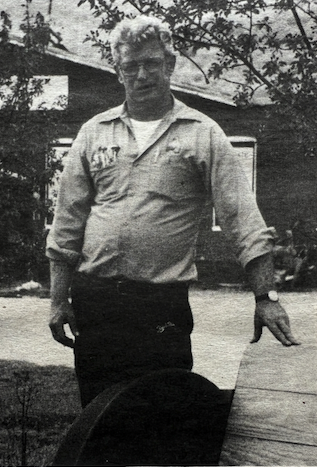
“It’s nice to have the experience of explaining what went on years ago… I enjoy talking with people about it,” says Roger Harrington. He has seen many changes at the Mill at Loon Mountain.
No group has done as much to transform the Town of Lincoln into the hub of North Country activity as Lincoln Mill Associates (LMA), the group that is responsible for the conversion of dormant paper mills into the Millfront Marketplace and associated projects that include the North Country Center for the Arts (NCCA) and a planned golf course.
Strategically located amidst New Hampshire’s White Mountains with all their natural attractions, the Mill at Loon Mountain provides Lincoln with such a diverse selection of shops, residential accommodations, and entertainment and recreational facilities that residents and visitors no longer have to go out of town to purchase necessities or to find recreational activities.
But at the same time LMA was making additional improvements in Lincoln, its directors kept one eye on the historic community’s past. With a Yankee determination to preserve as much of the mill architecture and historical artifacts as they could, they renovated them into shops and restaurants. Old mill-tools were preserved by converting them into useful and decorative objects for the buildings and grounds.
If there is one man who personifies the blending of old and new at Lincoln’s finest multi-use project everyone would agree that it would be Roger Harrington, the man who knows more about the Mill at Loon Mountain and its history than anyone else.
A native of Lincoln, Roger began working on the maintenance crew at Lincoln’s Franconia Paper Company in 1957. Through the years, he rose through the ranks to mill manager, gaining a love for every piece of equipment at the old mill.
He recalls a manifestation of that love from others working at the mill: the poem about the mill whistle. “I don’t know whoever dreamed it up, but it’s been around for years,” Roger said.
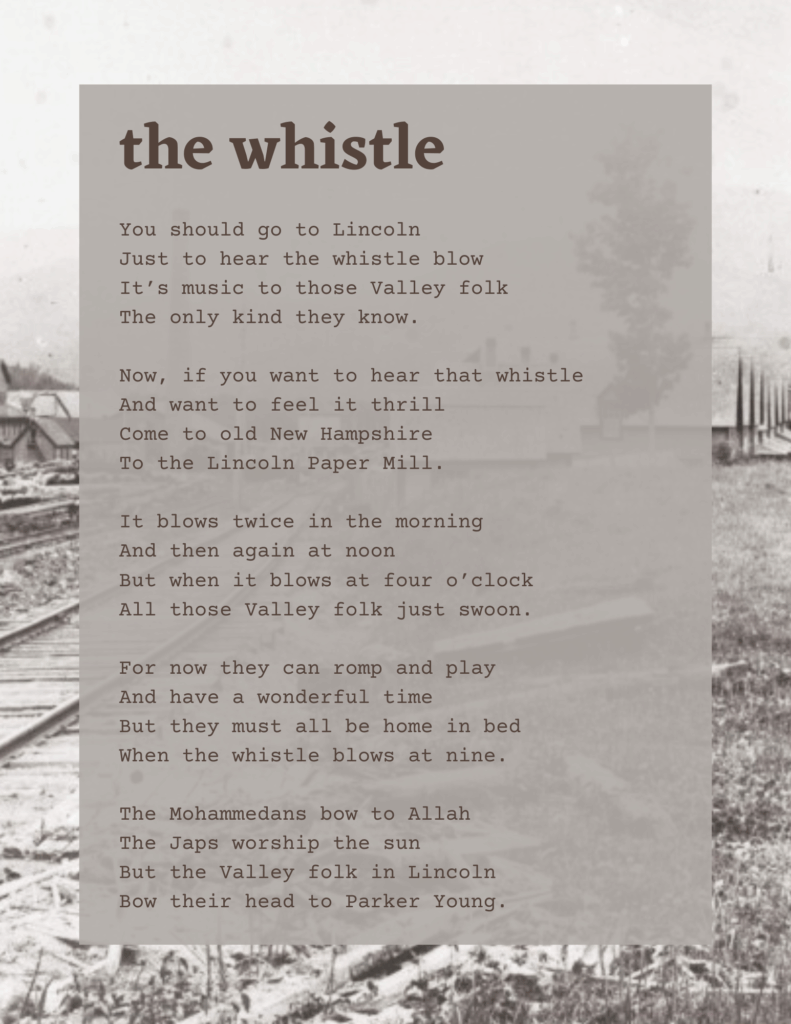
“The Whistle,” unknown author.
In those days, the paper mill took pulpwood and chipped it on-site in preparation for the papermaking process. The golden days for New Hampshire’s paper mills came to an end, however. As environmental concerns about the mills’ discharge into the Pemigewasset River grew and the industry came under tough regulatory control, things changed for the papermakers. Unable to discharge into the river, the mill operators found it difficult to keep the water they used clean.
As Roger explains it, “You’ve got to have lots of clean water to make clean paper. We tried to recycle it, but we couldn’t. We… could discharge so much into the town sewer system, and we still couldn’t discharge enough to keep clean water.”
Faced with costly purification processes that still did not do the job, Franconia Paper Company shut down in 1970. Over the next decade the mill changed hands several times: Franconia Manufacturing bought it first, then Profile Paper, New England Pulp and Paper. Finally, Franconia Manufacturing, under new management, acquired it again.
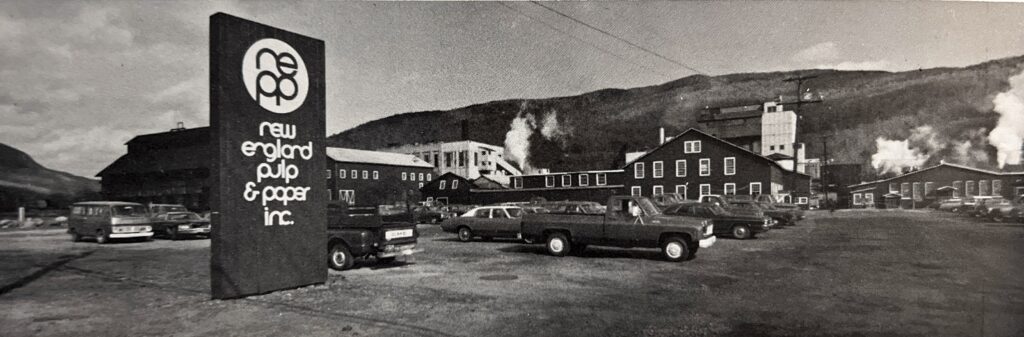
New England Pulp & Paper, Inc., Lincoln, New Hampshire
On June 11, 1980, the mill shut down for good, and the whistle would not be heard again.
Much of the serviceable equipment was sold to other paper mills. “Nothing that had any use was lost,” Roger recalls. “We put it to good use, unless it was junk.”
When the mill revitalization project began LMA partners Peter Gould and Tom Mullen envisioned a phased construction project that would include retail, residential, and entertainment components. Even the “junk” was put to good use. “Anything that’s got to do with the old paper mill that we can make things out of or display, we’re going to put them up,” says Roger, who stayed on with the new owners. “We’re packrats from way back.”
Now head of the building and grounds maintenance staff, Roger gives examples of some of the pieces that he and his crew have converted to new uses: Wheels from a railroad flatcar that used to go up into the Lincoln woods in the early 1900s to haul out the pulpwood are now displayed in the park. Woodroom gears that used to drive the conveyors have been used in the creation of benches in the Marketplace. One bench is made with wooden flatpulleys that came out of the woodshed.
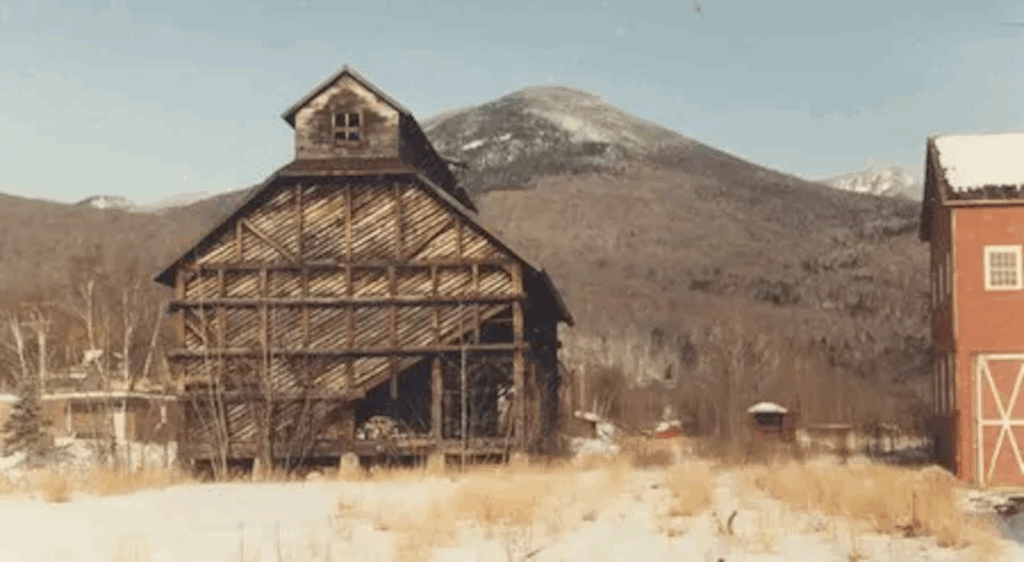
The Woodshed, Lincoln, New Hampshire
“We have a lot of other things that haven’t been displayed yet,” Roger cites. “We have the old watchman’s clock… that they used to carry around to do their fire watch… a lot of steam meters; a lot of plaques off machines.”
Many of the buildings, too, were converted to new uses. While some underwent demolition, the old mill room became headquarters for the North Country Center for the Arts. The woodshed became the Tavern restaurant. Carlos O’Brien’s Mexican restaurant used to be an old stockhouse with paper machines. Several of the market shops are located in what used to be old dry kilns.
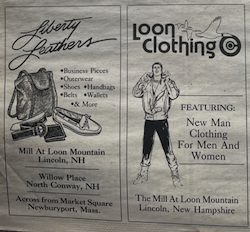
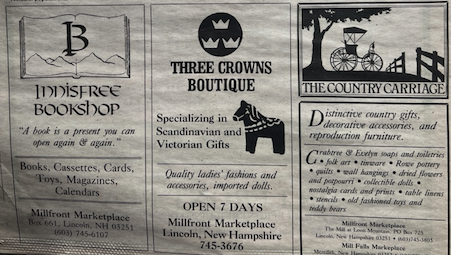
Millfront Marketplace Business Ads in the “North Country Times”, Summer 1988.
The former mill manager now works with three other members of his old crew—Billy Ramsey, Harold Judd, and Rene Lagasse. “They worked in the mill and they’ve been with me through the demolition, through the changes, and they’re on my maintenance force now,” Roger says. “It’s good to have guys like that that know where things are, too,” he added. “They’re all handy at making different trinkets, which they enjoy doing.”
Roger notes that what he terms “trinkets” have proven to be very interesting to visitors. He said that one man who came from out of state even wanted to purchase one of the old railroad wheels, something that Roger could see no value in. “It weighs about 900 pounds,” he said.
Roger also enjoys his newfound position as mill historian. Before, he said, he just worked with his crew; now he also deals with the public. “It’s nice to have the experience of explaining what went on years ago…I enjoy talking with people about it,” he says.
As a husband and father of five children, ranging in age from seven to 20, Roger Harrington remains a part of Lincoln. He has lived through many changes over the years and, while he may miss the old mill days, he is enjoying the new days just as much. And by making use of all those “trinkets,” he is making sure that the past will not die for those unfamiliar with it.
NOTES
- “Roger Harrington Personifies Lincoln’s Blending of Old and New.” North Country Times, Summer 1988, 4.


Great story. My dad worked in the boiler room for about 17 years and then went to Loon Mountain as the Outdoor Manager. He hired many unemployed mill workers when the mill shut down something he was proud of.
Wow! That’s incredible that he was so thoughtful and intentional about helping unemployed mill workers. What a legacy—he definitely should have been proud.