To the Summit by Dog Sled
By F. Allan Burt (The Story of Mount Washington, 1960.)
March 13, 1926, saw an event on Mount Washington so hazardous that it had been declared impossible. For on that day the dog Chinook led a team of Arthur T. Walden’s Alaskan huskies up the eight miles of winding, snow-packed, and icy Auto Road to the summit. What they learned of ice and hurricane must have stood them in good stead years later when Chinook led Walden’s dogs out over the glittering ice packs of Antarctica for Admiral Byrd. But they never faced greater peril than on the frozen flank of New England’s highest peak.
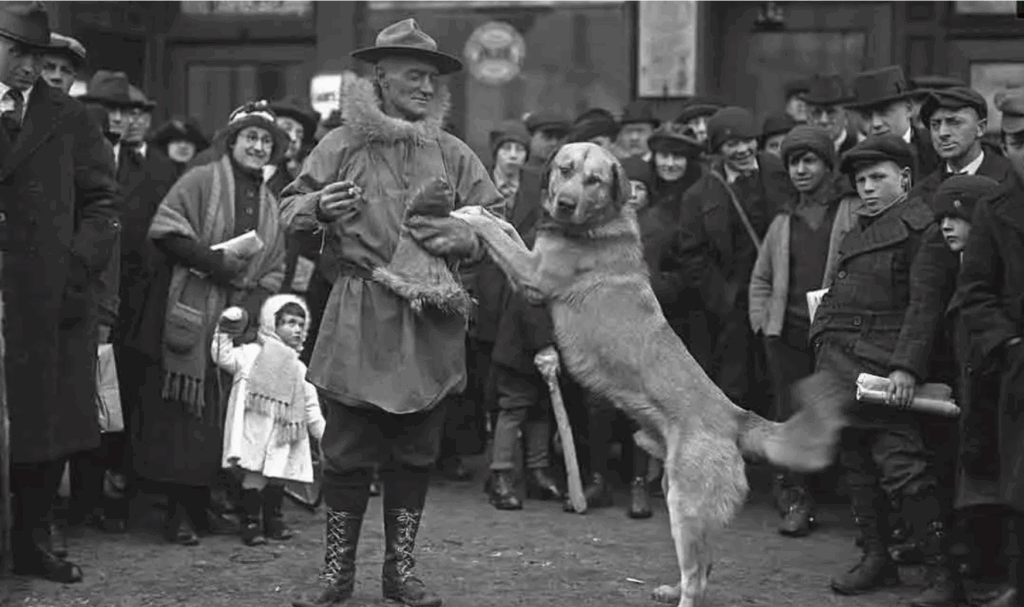
Arthur T. Walden stands with his famed lead dog, Chinook, surrounded by spectators at the Winter Carnival in Portland, Maine, on February 11, 1922—an early public glimpse of the legendary dog-sled team that would soon make mountaineering history.
Perhaps it was W. A. Macdonald of the old Boston Evening Transcript who suggested the expedition. At any rate, it gave him one of his most thrilling stories of adventure in the White Mountains, and it nearly cost him his life. Five years before that, Walden had discussed the trip with many Mount Washington old timers, but only Ray Evans, proprietor of the Willis House in Gorham, who had guided parties over the mountains in all sorts of weather, called the idea feasible.
Arthur Walden, Jake Coolidge of Pathé, and Bill Macdonald mapped out the plan, the trip to be undertaken the end of February. The chief danger was on the side slope above the Halfway House, where the snow melts and freezes into glare ice, which is always blown clear of snow. There the dogs could not keep their feet. Conditions had to be right or the attempt would fail. But that winter the ice was the worst in years. So it was after the middle of March before Walden was notified that the weather was suitable.
Sunday afternoon Walden drove Macdonald to the Glen House by dog sled. There they were joined by Coolidge and Ludwig Geiskop, both of Pathé News, Arnold Belher, Boston Photographer, Joe Dodge, Ray Evans, and Harold Mohn of Lynn, a skier. At two o’clock Monday morning they set out for the Halfway House, the dog team trotting ahead faster than any man could travel—except Walden. Fifty-five years old and tireless, he trotted behind, holding the handlebars seemingly without fatigue.
At the Halfway House it was zero, with a seventy-five mile wind that nearly blew the dog team off the mountain when they attempted to go around the Horn just above the house. So they turned back to the Glen House, and waited till seven Tuesday morning, when the wind had abated somewhat and the thermometer was up to twenty-four degrees as they started for the Halfway House. Again the ice at the Horn was bad, but with a tremendous effort Walden held the sled upward on its upper runner, and it went across.
There were other places nearly as bad. Yet time and again Ludwig Geiskop and Arnold Belcher climbed walls of ice above the dogs, and Ludwig with his little hand movie camera and Belcher with a newspaper camera gunned the team coming and going. How they reached some of these places… is… hard to say. For this was lung-bursting, heart-breaking climbing when legs were hard to life and lungs hard to supply with oxygen…. Besides, … these two men were equipped only with toy ice creepers bought in a city store and hardly better than worthless.
The party fought their way along to the lower spur of Chandler Ridge. With no stone wall to protect them, they found the icy sideslope nearly perpendicular. It was a full quarter of a mile down that wall of ice. Across it they started, Walden ahead with Chinook, Evans holding the sled. Now it was colder, and the wind had risen to a fifty-to-sixty-mile gale, on which the blown snow stung like steel shot.
The sled was slipping. The dogs stopped dead. The young dogs were beginning to bow downward in the middle of the line, and at any moment might start the wild dash downward which would have ended in death or injury to someone. “All but old Chinook. There the great dog stood at the head of the line unswerving…. Four feet planted, he stood there an example to his sons, a figure of strength, duty and courage. It was not enough.”
Then Bill Macdonald crept above the sled and grasped the knotted rope attached to it. Walden gave the word and Chinook started. Each man dug in his creepers and helped on the sled. They were near exhaustion, and could go only in short rushes. But finally they crossed the slope and fell flat on the snow to rest.
But Belcher and Geiskop were not in sight. Ray Evans took fifty feet of rope and went back. He found them braced against a rock that jutted out of the snow. With only a ski pole keeping them from sliding down that quarter mile of sheer ice, they had made their way to this rock, and clung there till Evans rescued them.
At 1:25 p.m. they reached the summit, to find that Joe Dodge and Mohn had gone ahead and started a fire in Camden Cottage, with hot soup, tea, and baked beans ready for the party.
At seven that evening they were at the Glen House, and quite ready for one of Mrs. Pike’s excellent dinners.
At that moment, no one would have dreamed that the feat of the Walden-Chinook party would ever be equaled, and surely not by a woman. But six years later, Mrs. Florence Murray Clark, of North Woodstock, New Hampshire, set up a new record as the only person to drive a dog team to the summit of Mount Washington without assistance.
Five feet three inches in height, and weighing perhaps 115 pounds, she was slim and wiry, quick in her motions, poised and active. She smiled broadly when telling of her experiences. Her eyes lighted as she talked about the friendliness, intelligence, strength, and willingness-to-work of her Eskimo dogs. “No matter how tough the going,” she would say, “they never lay down and quit. But sometimes I wonder why I did it.”
A good question for a girl born and brought up in New York City, who had never before climbed Mount Washington.
Mrs. Clark (then Miss Florence Murray) first learned about dogs when a neighbor, Edward P. Clark, in 1919, brought from Labrador a team of Eskimo dogs. From him she learned to drive dogs, and after their marriage on 10 November 1922 the couple moved to West Milan, New Hampshire, to raise dogs.
Six years later they moved, by dog sled, through the unbroken snow of Pinkham Notch to North Woodstock, New Hampshire, and started showing dogs and occasionally selling one.
Florence Clark used to drive about 2000 miles a winter in training for races, but this was on safe roads and trails in the lowlands.
It is one thing to drive dogs on a trail—quite another to drive up over the rocks and ice and hard-packed snowdrifts on Mount Washington in subzero weather, with winds that might blow the dogs into a huddle, and icy slopes that could avalanche sled and driver into ravines below.
John T. Brady of the Boston Post suggested the climb up Mount Washington.But after telling Brady that she was afraid of the climb, she set her fears aside and let him plan and take charge of her first trip. This was on 13 January 1932, a windy, squally, cloudy day, and it was a struggle all the way up for Mrs. Clark, five men, and eight dogs. They were almost at the summit, in thick clouds, when they found that Donnell, a photographer from the Boston Post, was unconscious. So they turned back to the Glen.
But now Florence Clark was determined to do what no other woman had attempted, and, on 21 February, she started again for the summit. Winston Pote, the photographer, went as a guide, with Richard Campaigna of Berlin and Asa C. Osborn of Boston. They started from the Glen at ten o’clock at night, hoping to reach the summit in time for a photograph there on the 150th anniversary of the birth of George Washington.
But again they were doomed to disappointment. At the fifth mile mark, trying for a shortcut over Nelson Crag—which is a bit like the side of a house—the dogs got into a fight; Pote got lost, and in the midst of a vicious frost storm covering them with rime, they turned back.
Then she decided to go again, and to go alone. After careful preparation, she started on 3 April, with five dogs and a sled loaded with 150 pounds of duffle—canned goods, sleeping bag, blankets, camera, gun, an axe, and other supplies. She had finally decided to take two good men with her, but at the last moment there was a mix-up of dates, and she went alone.
Florence Clark reached the Halfway House at seven that night. She had arranged with Elliot Libby of the Glen House that at seven each night she would set off a ten-minute railroad flare—one if all was well; two if she was in trouble.
She found the Halfway House with the door left open and the room full of snow—”a filthy mess left by some person with no sense of responsibility for the next person who might come in exhausted, and needing warmth quickly.” She cleaned the place, made her dogs and herself comfortable, and spent the night.
She had breakfast the next morning, and then went to the attic to find a pair of crampons which Win Pote had told her she might borrow. She opened the trunk and—no crampons! She was wearing high rubber boots with leather tops—almost useless on ice. Crampons are the number one essential in climbing in winter. But she was half way up and would not turn back.
They made a good start, and were approaching Nelson Crag. Clarkso, the lead dog, who never forgot a place, especially if it meant trouble, gave one dirty look at the Crag and another dirty look at Mrs. Clark, and stuck to the road.
At the Five-Mile Post, every winter, there is a huge sideling drift that covers the road for about three-quarters of a mile. It gets steeper and steeper as you ascend, and tops a two-thousand-foot slope that ends far below in jagged rocks. A slip there means almost certain destruction. The icy surface of the snow had melted enough for the runners to cut in, so the team got almost across when the sled struck ice, turned on its side, and started down the long incline. Florence yelled to the dogs; they had gone flat on their stomachs and were holding with their nails. She leaped over the sled and held it from below with her shoulder. Then something like the hand of Fate came to the rescue. For lashed to the sled, within her reach, was a spare axe she had picked up at the Halfway House.
Holding the sled with her shoulder, she managed to reach the axe, to chop a hole in the ice, and to thrust the handle deep into the drift to snub the sled from slipping. Swiftly, Mrs. Clark grabbed the axe she had brought from the Glen, and snubbed the sled a second time.
Although nearly exhausted she now had to unlash the load and carry it across the drift, before the dogs were able to pull the lightened sled to safely.
She placed one duffle bag containing the sleeping-bag, some canned food, a camera, a valuable gun of her husband’s, and other equipment on a rock. As the dog team passed this rock, a playful young dog, Kak, curious about the strange object, nosed the bag over the side, and down it slid for a thousand feet or more to disappear in the tangle of rocks and scrub at timber line!
Driving the dogs to safety, and chaining Clarkso, Mrs. Clark lay on the snow and rested till she felt able to attempt the rescue of her precious duffle bag. Then, sitting on the snow and using the axe as a brake, she slide the thousand feet, to find the bag snubbed against a tree. It took a minute or so to slide down. But it was more than an hour later before she had inched her way back to the sled. This she accomplished by chopping out a step at a time with the axe. Then swinging it with her right hand, to drive it into the icy crust above her, she pulled herself up, hanging onto the axe handle with one hand and pushing the duffle bag ahead with the other. After that, holding the bag with her head, she would cut another step and repeat the terribly slow and tiring process.
Near Chandler Ridge, when they were headed for a drop into the Great Gulf, Mrs. Clark turned the lead over to Clarkso, who led the team up over a huge drift and around a treacherous field of ice. Here they lay down to rest.
A moment later they were surprised by a man with a huge dog. The man was Robert Scott Monahan, who, during his undergraduate years at Dartmouth, had become familiar with Mount Washington, and who even then was planning the weather observatory of 1932-33.
Monahan gave Mrs. Clark his crampons, but she insisted on completing the climb to the summit without help. There she planned to spend the night resting. But Bob Monahan insisted there was a storm coming on, and that they must get down to the Glen.
At seven o’clock, Bob set off the “all clear” flare, answered by flashing lights from the Glen House. Somewhere below the Halfway House Mrs. Clark and Bob were met by three or four men who had come up (as they thought) for a rescue. For the flare set off on the icy crust had been reflected so that from the valley there were distinctly seen two flares, the signal for trouble.
There is a thought by George Leigh Mallory, who lost his life on Mount Everest, that applies to all such records: “Are we defeating an enemy? … No, we are simply overcoming our own weakness and fear.”
There is just one more dog story that came as an aftermath of the tragedy of 31 January 1932, when Ernest McAdams and Joseph Chadwick were frozen to death near the Lizzie Bourne monument, almost at the summit. Informed of the tragedy in his office at the Boston Transcript, Bill Macdonald at once phoned Norman D. Vaughan of Hamilton, Massachusetts, sportsman and dog-sled driver who had been at the South Pole with Admiral Byrd. Without delay, Vaughan sped to Boston in his big open car, picked up Macdonald, and soon they were speeding northward over icy roads. After midnight they paused briefly in North Woodstock, where they wakened Ed and Florence Clark, and were rewarded with five Labrador Eskimo dogs and a sled.
From the Base Station the trail up the mountain was the railway trestle, and a dog team on a slippery trestle was a matter of gambling. It took all of the two men’s strength, and all of Vaughan’s know-how with dogs, gained in Newfoundland and on a fifteen-hundred-mile, three-month travel by dog team in Little America, to get the team one mile up the track to the Waumbek Tank. It was a day of hurricane winds, sleet, and a temperature of twenty-five below zero. The clothes of the searchers who had preceded Vaughan and Macdonald up the trestle froze solid on them. Their faces were beaten red by ice. But they brought the two frozen boys down on toboggans, Vaughan taking Chadwick’s body the last mile by dog sled, to the great relief of the nearly-exhausted rescuers.
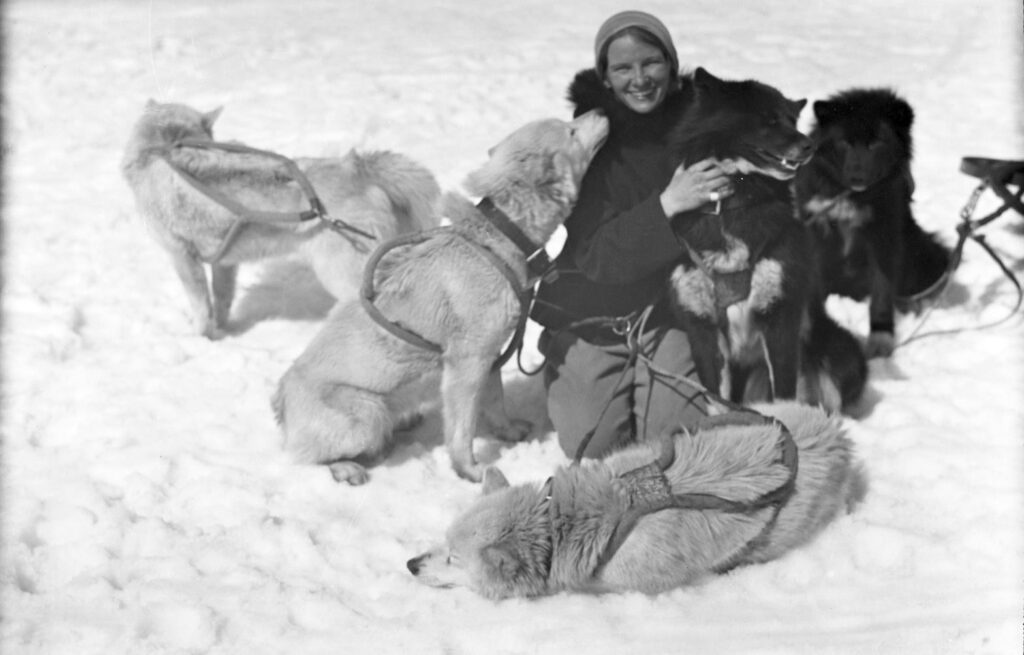
Mrs. Florence Clark’s triumphant “victory smile” at the summit of Mount Washington following her remarkable dog-sled ascent on April 5, 1932. Her lead dog, Clarkso, and Nanook, stand at center, embodying the grit and loyalty that carried the team to the top.
FROM FLORENCE MURRAY CLARK’S OBITUARY
Bob Monahan writes: “… Mrs. Clark had a burning desire to become the first woman to drive a dog sled to the roof-top of New England. Arthur Walden of Wonalancet had accomplished that much for the men in 1926, but she was determined that a woman should not be far behind. The winter of 1932 looked like the best bet. Twice she tackled Mount Washington via the eight-mile carriage road and twice she returned disappointed. The third time she would try it alone! … There were other sled dog trips before the end, but none of them approached the supreme effort Florence Clark made successfully as winter released its grasp upon Mount Washington back in 1932.”
NOTES
- Burt, F. Allan. “To the Summit by Dog Sled.” In The Story of Mount Washington, 159–165. Hanover, NH: Dartmouth Publications, 1960.
- Monahan, Robert S. The Victor’s Smile. Photograph, April 5, 1932.
- Photograph, Maine Historical Society/MaineToday Media, originally published on the front page of the Evening Express (Portland, ME), February 11, 1922.


Thank you so much for these great stories.l am 83 and remember many of your references but but not all the details. When I was about 12 my family went for a Sunday drive and stopped at the Chinook Kennels in Wonalancet. I had no idea the history behind it. I’m so happy to know more!